Home / Technology / Tech News / NASA CHAPEA 1 mission: Locked volunteers inside Mars simulator for 378 days
NASA CHAPEA 1 mission: Locked volunteers inside Mars simulator for 378 days
NASA began its ambitious mission by locking four volunteers inside a Mars simulator, CHAPEA 1 for 378 days. It is one of the three simulators that volunteers will have to experience in the future
NASA locked four volunteers inside a Mars simulator, called CHAPEA 1
National Aeronautics and Space Administration (NASA) began its ambitious Mars mission, where they locked four volunteers inside a Mars simulator, called CHAPEA 1, on June 25.
CHAPEA 1 is the first of three simulators that volunteers will have to experience for the forthcoming time. The four-person crew entered their new home at NASA’s Johnson Space Center in Houston to begin a 378-day Mars surface simulation.
During the process of the CHAPEA 1 simulation, the volunteers will have to undergo different types of mission activities. The activities include simulated spacewalks, robotic operations, habitat maintenance, personal hygiene, exercise, and crop growth. The simulator is developed to be as Mars-realistic as feasible, the crew will also face environmental stressors such as resource limitations, isolation, and equipment failure.
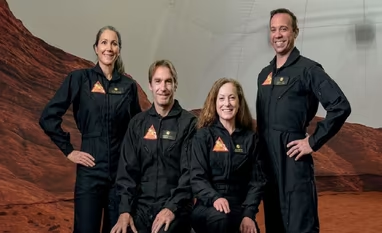
The four challengers who chose to be part of this challenging task are Kelly Haston, a research scientist; Ross Brockwell, a structural engineer; Nathan Jones, an emergency medicine physician; and Anca Selariu, a US Navy microbiologist. This Mission will last for the span of an incredible 378 days.
Grace Douglas, the mission leader, advances her best wishes to the volunteers and also expresses her gratitude for their dedication to exploration. Kally Haston will lead the mission, and she highlighted the crew member's passion for space exploration, and she also mentioned that the crew members are excited about the mission. She stated, "We are a fantastic group of scientists working together to make CHAPEA 1 a reality."
There are different spaces, like private rooms, a kitchen, medical care room, an exercise space, a workspace, a farming area, and even a bathroom. All this is delicately designed within a limited space of 1700 square feet.
According to NASA, the results of CHAPEA and the knowledge gained from the analogs could impact future NASA missions including those to the surface of Mars.

 "NASA CHAPEA 1 mission: Locked volunteers inside Mars simulator for 378 days")


 Connect with us on WhatsApp