
Choice of arm for 2nd Covid jab could influence immune response: Research
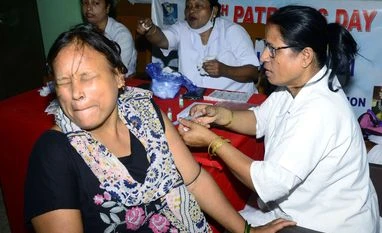
Individual doses of two-dose vaccine-regimens are consecutively administered into the deltoid muscle, which is the large triangular muscle covering the shoulder joint
 "Choice of arm for 2nd Covid jab could influence immune response: Research")
Explore Business Standard
Individual doses of two-dose vaccine-regimens are consecutively administered into the deltoid muscle, which is the large triangular muscle covering the shoulder joint
Getting the second Covid jab on the same arm as the first one or on the opposite arm could influence the body's immune response generated against the SARS-CoV-2 virus, new research from Germany says.
Those who got jabbed on the same side, or ipsilaterally, generated more antibodies against the Covid-causing pathogen than those who got jabbed on the opposite side, or contralaterally, the study from Saarland University and other German institutes found.
Further, median levels of infection-fighting CD8 T-cells generated in response to the spike-protein of the pathogen were found to be significantly lower in those contralaterally vaccinated. CD8 T-cells destroy virus-infected cells and render protection against severe disease.
Consequently, after contralateral vaccination, fewer individuals (43 per cent) were found to have detectable levels of CD8 T-cells than after ipsilateral vaccination (67 per cent), the study published in the journal eBioMedicine said.
Individual doses of two-dose vaccine-regimens are consecutively administered into the deltoid muscle, which is the large triangular muscle covering the shoulder joint.
However, "little attention has so far been paid to the immunological effects of choosing the ipsilateral or the contralateral side for the second dose," the authors wrote in the study.
The study was performed in 303 never-infected individuals (aged 24-55), of whom 147 received the second Pfizer BioNTech COVID-19 vaccine dose on the ipsilateral side and 156 on the contralateral side. Blood samples were drawn 15 days after the second dose and measured for antibodies and immune T-cells produced in response to the SARS-CoV-2 spike.
While both ipsilateral and contralateral vaccination induce a strong immune response, secondary boosting was more pronounced when choosing the same routes used for administering the vaccine the first time, the researchers wrote in the study.
This may be because after ipsilateral vaccination, boosting of the immune response after the first and the second dose both occurred through the same lymph nodes, which is where the infection-fighting fluid containing CD8 T-cells is produced, they wrote.
This was supported by previous research which, they said, demonstrated that ipsilateral lymph nodes where the vaccine had been applied were significantly larger in size and showed higher metabolic activity compared to the contralateral lymph nodes.
Considering these findings, "the choice of arm for the second vaccination represents a previously unappreciated factor that may contribute to overall vaccine effectiveness on a population level", the authors wrote in the study.
(Only the headline and picture of this report may have been reworked by the Business Standard staff; the rest of the content is auto-generated from a syndicated feed.)
First Published: Aug 12 2023 | 6:09 PM IST


