Russian Foreign Minister Sergei Lavrov said on Monday that the support of the United States, Britain and France for Ukraine was stoking serious strategic risks that had raised the risk of a direct confrontation between the world's biggest nuclear powers.
Lavrov said the United States and NATO were obsessed with the idea of inflicting "strategic defeat" on Russia and there were risks in such confrontation that could lead to an increased level of nuclear danger.
"The Westerners are teetering dangerously on the brink of a direct military clash between nuclear powers, which is fraught with catastrophic consequences," Lavrov said.
The United States and its allies say they are helping Ukraine to defend itself against Russian aggression and that it is Russia that is aggravating East-West tensions, including by issuing repeated warnings about the danger of a nuclear conflict.
Lavrov said: "Of particular concern is the fact that it is the 'troika' of Western nuclear states that are among the key sponsors of the criminal Kyiv regime, the main initiators of various provocative steps. We see serious strategic risks in this, leading to an increase in the level of nuclear danger." The three Western countries with nuclear weapons are the United States, Britain and France.
HOT WAR?
As relations have deteriorated, Russia and the United States have both voiced regret about the disintegration of the web of arms-control treaties which sought to slow the Cold War arms race and reduce the risk of nuclear war.
Russia and the United States are by far the world's biggest nuclear powers, holding more than 10,600 of the world's 12,100 nuclear warheads. China has the third largest nuclear arsenal, followed by France and Britain.
Lavrov said that given the current crisis there was no basis for dialogue with the United States on arms control.
"In the context of an all-out hybrid war being waged against us, there is no basis for dialogue with the United States on arms control and strategic stability in general," he said.
He accused the West of trying to impose restrictions on the nuclear arsenals of Russia and China while developing non-nuclear capabilities in an effort to achieve unilateral military superiority.
Lavrov said the West was building a global missile defence system which could decapitate a rival, basing nuclear weapons in Europe, basing medium- and shorter-range missiles in regions around the world and preparing to deploy weapons in space.
In February, Putin said Russia opposed the deployment of nuclear weapons in space, and his defence minister denied Washington's accusations that Russia was developing a nuclear capability for space.
The United States says it is developing its defence capabilities in accordance with international agreements. It says it wants only the peaceful use of outer space and that its missile defence plans are defensive.
Lavrov also accused the West of waging a propaganda campaign to discredit Russia.
The West's "goal is to divert attention of the international community from real threats in outer space, to achieve the allocation of additional financial resources to build up their national military space capabilities," Lavrov said.
"Our priority remains the development of an international legally binding instrument that establishes reliable guarantees to prevent the deployment of weapons in outer space."
Lavrov Says Russia, China Almost Dedollarized Their Trade: Tass
Russia and China have almost completely stopped using the dollar in their mutual trade, Foreign Minister Sergei Lavrov said in Moscow on Monday, according to Tass. More than 90% of settlements are carried out in the two countries’ national currencies, Lavrov said. Trade and economic cooperation between Russia and China is actively developing despite persistent attempts by Western countries to prevent this, he added. Economic ties between the two countries have boomed since Russia invaded Ukraine in 2022 and the West imposed sanctions. Trade between Russia and China increased by 26% to $240 billion in 2023. (Bloomberg)

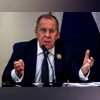 "West teetering on brink of conflict between nuclear powers. says Russia")

