


Home / India News / Bengaluru's Brain Museum is an experience for the curious and brave
Bengaluru's Brain Museum is an experience for the curious and brave
Apart from promoting organ donation, the museum's goal is also to de-stigmatise issues that engulf mental health, says Shankar
 "Weekend")
premium
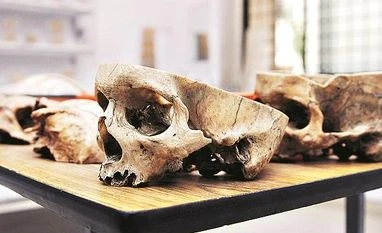
Exhibits of skulls and brains of people who had suffered cerebrovascular diseases
Last Updated : May 04 2018 | 10:06 PM IST
Some of the toughest questions to be tackled on the usually quiet campus of the National Institute of Mental Health and Neurosciences (Nimhans) in Bengaluru come from the batches of school students who visit the campus regularly: If a person has two heads, which head will control the body? Are brain transplants possible? What happens when we sleepwalk? Where is the soul? What about the mind? Where do dreams come from?
The ones who are often at the receiving end of these questions are Shwetha S D and Hemalatha B N, part of the team that runs the one-of-a-kind Brain Museum in Bengaluru. “Children ask the most unexpected questions,” says Anita Mahadevan, coordinator, the Human Brain Bank. “Elders tend to be more fearful, but children are just curious.”
Surrounded by over 400 brains preserved in formalin which is refreshed every two months, the questions flow freely. The museum, a large white-painted room, draws widely divergent reactions. Some remain in stunned silence, others can’t stop asking questions. There’s even a shriek or two, especially when the white cloth is pulled off a tray resting on a table.
In the tray are a few human brains — not clay models, but actual specimens of different sizes and ages. Hours after you’ve left the place, the memory of the cool water against your skin lingers on, reminding you of the time you dipped your hands into the tray and picked up a brain. You also remember how you had to use both your hands to hold the soft brain tissue, or how a pair of lungs lying next to the brain had turned black owing to pollution.
Shwetha S D, Hemalatha B N, S K Shankar and Anita Mahadevan make up the team running the Brain Museum in Bengaluru
Managed by the department of neuropathology, the Brain Museum is the only one of its kind where the public can see a brain up close and also hold it. Guided tours are held twice a week to help those with non-medical backgrounds understand the brain better.
Mahadevan picks up a brain resembling a loaf of sliced bread from the tray and points out the grey and white matter regions of the brain along with the almond-shaped amygdala. “This part (the amygdala) is stimulated when we learn something through examples and stories. The amygdala is involved with emotional responses, so we tend to remember those lessons better,” she says. The reason the cerebral cortex is wrinkled is to pack more matter into the space enclosed by the skull, adds the team.
The brains here are as different as people can be. There’s a brain with evidence of the ravages caused by tapeworm; there’s one to show the effects of a road accident on a biker who was not wearing a helmet; there’s another, belonging to a young man, with a brain abscess. “People often use pencils, pens or even hairpins to scratch the inside of their ears. It can be fatal when the infection spreads to the brain,” says S K Shankar, a retired professor emeritus and former principal coordinator of the Brain Bank. He is also the man responsible for opening the museum to the public seven years ago.
Shankar remembers people standing at the edge of the door, popping their heads in to see what brains looked like. He would invite them in. At the time the museum could only be accessed by the medical community comprising students, doctors and researchers. Shankar says that the idea behind keeping these specimens is to promote a culture of prevention. Seeing the consequences of everyday actions like digging into one’s ear with a pen or eating unhygienically prepared food, people tend to be more careful, say Shankar and Mahadevan.
“You can’t forget it once you’ve actually seen how these things can affect your brain. It’s a powerful message,” they say. They’ve even had parents coming over to tell them how, after a visit to the museum, their children have begun to wash their hands before meals.
Apart from promoting organ donation, the museum’s goal is also to de-stigmatise issues that engulf mental health, says Shankar. “Here you can see how there’s no physical difference between the brains of those who’ve had epilepsy, depression or schizophrenia and that of a person without these conditions,” says Shankar. This tends to give patients and their families a sense of normalcy, adds Mahadevan.
There are posters all over the room, and even on the boards outside, on men and women who have lived with, and continue to live with, some of these conditions. From cricketer Jonty Rhodes to scientist Isaac Newton and Roman general Julius Caesar, epilepsy has stuck many well-known names, one such poster informs you. Ernest Hemingway, Charlie Chaplin, Robin Williams and Marilyn Monroe suffered from depression, declares another, adding contemporary names like those of Deepika Padukone and Angelina Jolie to the list.
Every week, some 30 people visit for the two guided tours that the museum offers. “Besides a general understanding of degenerative diseases, these exhibits also help families understand what their loved ones are going through,” says Mahadevan. For instance, a shrunken brain on one of the shelves shows the effect of Alzheimer’s disease on the brain.
Exhibits of skulls and brains of people who had suffered cerebrovascular diseases
The older visitors usually want to know about the prevention and progression of such conditions and also about exercises to keep the brain healthy. Youngsters and college students are often interested in conditions such as multiple personality disorder.
Questions about such conditions have gone up since the release of films like the Aamir Khan-starrer Ghajini (the Hindi remake of a Tamil film inspired by Christopher Nolan’s Memento which was about anterograde amnesia or short-term memory loss) or Taare Zameen Par (on dyslexia), chuckles Shankar.
A poster also lists some of the movies based on neuropsychiatric conditions. These include My Left Foot and The King’s Speech (social anxiety disorder), Clean, Shaven (schizophrenia), Shutter Island (dissociative schizophrenia), Rain Man and Forrest Gump (autism), Regarding Henry (traumatic frontal lobe injury) and Eternal Sunshine of the Spotless Mind (lacunar amnesia).
“When we don’t know the answers to some of the questions visitors ask, we tell them that. And we tell the children that they should research these questions when they grow up and come back to us with the answers,” says Shankar.
The museum also houses a selection of fish, bird, dog and cat brains, alongside their skulls, so people can compare them to the human brain. Enriching and informative as it is, a visit to the Brain Museum is perhaps not for the faint-hearted. But donating your brain (and body) for research — that’s something everyone can do.
For more, call 080-26563357, or write to nimhansbrainmuseum@gmail.com