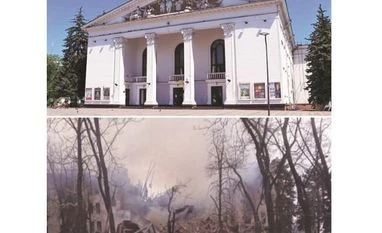
The ministry said many people were trapped in the theatre and accused Russia of committing a war crime. It said the number of casualties was not yet known. Reuters could not independently verify the information.
Russia denies targeting civilians. In Moscow, the defence ministry said its forces had not struck the building and instead accused the Azov Battalion, a far-right Ukrainian militia, of blowing it up, RIA news agency said.
Governor of the northern Chernihiv region said 53 civilians had been killed there in bombardment over the past 24 hours.
Talks between Russian and Ukraine continue via video link for a fourth straight day. Heavily outnumbered Ukrainian forces have prevented Moscow from capturing any of Ukraine's biggest cities so far despite the largest assault on a European state since World War Two.
More than 3 million Ukrainians have fled and thousands of civilians and combatants have died. Northeastern and northwestern suburbs of Kyiv have been reduced to rubble by heavy fighting, but the capital itself has held firm, under a curfew and subjected to deadly nightly rocket attacks.
21 dead as Russian shelling hits school and cultural centre
At least 21 people were killed and 25 were injured on Thursday when Russian forces shelled a town in eastern Ukraine, local prosecutors said.
Artillery fire early Thursday hit a school and a cultural centre in the town of Merefa outside the city of Kharkiv, regional prosecutors said in a Facebook post. Of the wounded, 10 people are in serious condition, they said.
A photo accompanying the prosecutors' statement showed a building of several storeys that was destroyed in the middle with windows blown out and emergency workers combing through the wreckage.
Russians have up to $213 billion stashed offshore in Swiss banks
Switzerland's secretive banks hold up to $213 billion of Russian wealth, the country's financial industry
association estimates, as sanctions on Russia give a rare glimpse inside Swiss vaults. The Swiss Bankers Association (SBA) estimated that the banks hold between 150 billion and 200 billion Swiss francs ($213 billion) of Russian client money in offshore accounts.
This indicates that the extent of wealthy Russians' business with banks in Switzerland, the world's biggest centre for offshore wealth, is far more extensive than the on-balance sheet exposures several of its financial firms have begun to detail. The Swiss economy ministry said that it had no meaningful estimates on frozen Russian assets as it tallies reports from banks facing a growing Swiss sanctions list.


 "Russia-Ukraine conflict")

