


Bajaj Auto Q4 results: Net profit falls 10.4% to ₹1,802 cr; revenue up 8%
The decline in the net profit was attributed to subdued performance in the domestic motorcycle market
 "bajaj auto, auto")
For FY25, Bajaj’s net profit fell by 5 per cent Y-o-Y, reaching ₹7,325 crore, while revenue from operations grew by 12.5 per cent, hitting ₹49,267 crore.
Listen to This Article
Two-wheeler major Bajaj Auto on Thursday reported a 10.4 per cent year-on-year (Y-o-Y) decline in their consolidated net profit at ₹1,802 crore for the fourth quarter of financial year 2024-25 (Q4FY25), whereas its revenue from operations grew by 8 per cent, reaching ₹12,204 crore.
The decline in the net profit can be attributed to subdued performance in the domestic motorcycle market coupled with market volatility.
For FY25, Bajaj’s net profit fell by 5 per cent Y-o-Y, reaching ₹7,325 crore, while revenue from operations grew by 12.5 per cent, hitting ₹49,267 crore.
On Thursday, Bajaj Auto stock grew by 0.28 per cent, ending the day’s trade at ₹8,873.3. The results came after market hours.
The company revealed that the auto industry continues to face uncertainty over rare earth imports from China, with no clear resolution yet on the clearance process. Over 30 applications from Indian importers remain pending, raising concerns about production disruptions starting July due to depleting stocks.
Also Read

 "bajaj auto pulsar bikes two wheelers")
 "Bajaj Auto showroom")
 "Bajaj")
 "Madhur Bajaj")
Speaking to reporters, Rakesh Sharma, executive director, Bajaj Auto, said: “The rare earth situation remains difficult. While a defined process involving multiple certifications is in place, we’ve yet to see any clearances coming through. If shipments don’t resume soon, production across the industry will be seriously impaired by July.”
The company revealed that there is no immediate resolution required in the ongoing process related to sourcing from China, as a structured framework has already been set into motion. As many as 38 applications, certified by the Chinese Embassy in India, are currently at various stages of clearance in China. ALSO READ: RBI balance sheet grows 8.2% to ₹76.25 trillion in FY25, surplus up 27%
While the bottom line impact may be limited in the near term, the electric vehicle (EV) segment could face headwinds if the situation persists. Efforts to simplify processes and accelerate localisation are expected to offer some relief over the course of the year.
“The entire EV business is at risk. While the bottom line may see a marginal impact, nearly 20 per cent of our annual revenue is linked to the EV segment, making the top line more vulnerable. We’re hopeful that process simplification, smoother execution, and ongoing automotive developments through the year will offer some mitigation,” added Sharma.
Acknowledging the heavy reliance on Chinese imports — nearly 80 per cent of relevant components — the company said there is no short-term alternative currently available. While rare earth reserves exist in countries including India, the development of local extraction and refining capabilities would require significant investment and time. Substituting heavy rare earth magnets with other materials is technically feasible but would necessitate redesigning and validating components — an exercise that cannot be completed quickly.
Commenting on export outlook, Sharma added: “We expect to grow exports by 15-20 per cent, reaching 165,000 to 175,000 units. Latin America remains strong with leadership positions for Pulsar and Dominar, which posted their highest-ever export sales in FY25. Out of 30 key markets, 26 are growing, and our growth is outpacing the industry. Asia is recovering well while Africa remains fragile due to macroeconomic pressures.”
Bajaj Auto recently announced that through its wholly owned subsidiary Bajaj Auto International Holdings BV, it intends to take majority control of the KTM business headquartered in Austria, subject to necessary regulatory approvals. The company noted that these approvals are expected to take two-to-three months, during which the current corporate and control structures will remain unchanged.
Once approvals are secured, Bajaj plans to work closely with KTM to strengthen its position in the high-performance sports bike segment. Despite export disruptions in FY25 related to KTM, Bajaj’s joint product manufacturing in India has driven strong domestic performance, and KTM exports are expected to resume in earnest from Q2FY26 onward.
In FY25, for the first time, Bajaj reported total income of over ₹50,000 crore, up 12 per cent Y-o-Y, supported by higher sales of vehicles and spares. Volumes rose 7 per cent driven by domestic demand in the first half and a recovery in exports in the second.
EV revenue crossed ₹5,500 crore, accounting for 20 per cent of domestic sales, aided by a PLI-certified portfolio and improved unit economics for the year.
Similarly, exports grew in double digits and were $100 million short of the FY22 peak. Latin America posted higher volumes while Asia showed signs of recovery. Pulsar and Dominar recorded higher export sales.
Pulsar crossed ₹10,000 crore in domestic motorcycle revenue in FY25. The Freedom model recorded ₹500 crore in revenue within five months. KTM and Triumph reported 100,000 unit sales, helped by new models and wider dealership coverage.
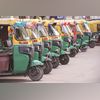
For FY25, commercial vehicle (CV) revenue crossed ₹10,000 crore. Bajaj retained over 75 per cent market share in internal combustion engine (ICE) three-wheelers (3Ws). Electric 3W volumes increased fourfold. The new GoGo platform and over 850 dealerships are intended to support further expansion.
In electric two-wheelers (e2Ws), Chetak volumes more than doubled for the year. Its market share increased 900 basis points (bps) Y-o-Y. The 35 series and a broader network contributed to overall sales.
For the quarter, the growth in revenue came from premium motorcycles, e-scooters, CVs, and higher export volumes. Revenue was partially offset by the temporary suspension of KTM exports.
In Q4, domestic motorcycle sales were subdued. Pricing actions and product changes were undertaken to address the trend.
Chetak’s 35 series made up 60 per cent of Q4 e-scooter volumes, which doubled Y-o-Y.
Export volumes rose 20 per cent Y-o-Y across Latin America, Africa, and Asia. Export revenue was affected by the KTM export suspension amid restructuring concerns.
Premium motorcycles under KTM and Triumph saw higher domestic sales. Triumph volumes reached 12,000 units. Expansion into Tier-II and -3 cities is in progress.
More From This Section
 "IFFCO (Photo: Company Website)")
 "Nuvama, Nuvama group")
 "Ola Electric, OLA")
 "Wockhardt chairman Habil Khorakiwala")
 "Dish TV")
Topics : Bajaj Auto Bajaj Group Q4 Results
Don't miss the most important news and views of the day. Get them on our Telegram channel
First Published: May 29 2025 | 8:56 PM IST