


India likely to secure first trade deal amid US tariff push: Treasury Secy
India is on the brink of becoming the first nation to clinch a trade pact with the US, potentially dodging Trump's steep 26 per cent tariff and deepening economic ties
 "PM Modi, Donald Trump")
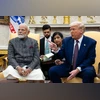
Prime Minister Narendra Modi and US President Donald Trump (Image: Bloomberg)
Listen to This Article
US Treasury Secretary Scott Bessent has indicated that India is on track to become the first country to finalise a bilateral trade agreement aimed at avoiding President Donald Trump’s proposed reciprocal tariffs.
During a media roundtable held alongside the annual meetings of the World Bank and the International Monetary Fund in Washington, Bessent said trade negotiations with India are nearing completion. He attributed the progress to India’s relatively open trade practices.
“India also has fewer non-tariff trade barriers, obviously, no currency manipulation, very, very little government subsidies, so that reaching a deal with the Indians is much easier,” Bessent told reporters, as quoted by the New York Post.
Looming tariff deadline
India currently faces a 10 per cent tariff under existing US policy, along with a proposed 26 per cent ‘reciprocal’ tariff on its exports, which has been temporarily paused for 90 days. That pause is set to expire on July 8. The higher tariff is part of a broader strategy by President Trump to pressure trading partners into lowering trade barriers and reducing the US trade deficit.
Stronger ties on the agenda
On Tuesday, US Vice President JD Vance, speaking in Jaipur, urged India to expand its markets and reduce non-tariff barriers. He also urged New Delhi to increase imports of American energy and military equipment, framing these measures as steps toward a more robust US-India partnership.
Also Read

 "JD Vance, Vance Taj Mahal visit")
 "Jamieson Greer")
 "JD Vance, Vance")
 "Donald Trump, Trump")
 "JD Vance, JD Vance in India, JD Vance India")
Vance outlined a strategic vision for closer collaboration between the two democracies in pursuit of a ‘prosperous and peaceful’ 21st century.
India’s role in US trade
According to the New York Post, which cited US Census Bureau data, India made up nearly 3 per cent of American imports as of February. The Office of the US Trade Representative reported a $45.7 billion trade deficit with India in 2024.
Despite this gap, Bessent remained optimistic, noting that India’s relatively low tariffs and trade barriers make it a more straightforward partner in ongoing negotiations. “India doesn’t have so many high tariffs,” he added, suggesting a smoother path to agreement compared to other nations.
What is the Bilateral Trade Agreement?
The Bilateral Trade Agreement (BTA) forms a key component of a broader US-India initiative titled ‘Catalysing Opportunities for Military Partnership, Accelerated Commerce & Technology’.
Launched in February 2025, this strategic programme is aimed at strengthening economic and military ties between the two nations, focusing on enhanced cooperation in areas such as trade, technology exchange, and defence collaboration.
US reciprocal tariff policy
As part of a revised trade framework announced by President Trump on April 2, the US imposed a 26 per cent reciprocal tariff on imports from India. This move aligns with Washington’s broader push to address trade imbalances and enforce equal treatment for American goods abroad.
In addition to the reciprocal measure, a general 10 per cent tariff has been applied to all US imports starting April 5.
Some critical sectors have been excluded from the reciprocal tariff regime. These include pharmaceuticals, semiconductors, and a range of energy commodities such as oil, gas, coal, and liquefied natural gas. These exemptions aim to safeguard industries vital to both countries' economic and strategic interests.
[With agency inputs]
More From This Section
 "ATTACK, DEFENCE FORCES, PAHALGAM ATTACK")
 "Sanjay Malhotra, RBI")
 "PMI, PMI INDIA")
 "caste Census India, SECC 2011 caste data, caste-based enumeration India, caste data confidentiality, caste Census political debate, caste Census 2025 demand, caste representation in politics, SC ST OBC Census India, caste data unpublished SECC, affir")
 "PLI scheme India, electronics manufacturing India, Dixon Technologies PLI, Amber Enterprises PLI, Tata Electronics investment, Murugappa Group electronics, Foxconn India investment, TDK Corporation India, AT&S Austria India, Murata Manufacturing Indi")
Don't miss the most important news and views of the day. Get them on our Telegram channel
First Published: Apr 24 2025 | 1:27 PM IST