


Six months of a Trump Presidency later, India-US ties hit a crossroads
Despite both Trump and Modi getting off to a warm start and a first-mover advantage for India in trade talks, recent developments suggest the going may not be as easy as initially hoped
 "Modi Trump")
premium
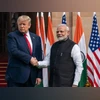
The Trump Administration at the end of July announced a 25 per cent tariff on imports from India. | File Photo | PTI Photo
7 min read Last Updated : Aug 05 2025 | 4:49 PM IST
Listen to This Article
Six months ago, when Donald Trump returned to the White House as the 47th President of the United States (US), he made his objective clear: ‘Make America Great Again’. As a part of the agenda, the US administration turned to the use of tariffs as a key tool to raise government revenue, boost domestic manufacturing, and create jobs.
What also stood out was Trump’s apparent closeness with India's Prime Minister Narendra Modi. Just three weeks after Trump's inauguration, Modi arrived in Washington D.C. for a high profile meeting. Both leaders announced plans to finalise the first tranche of a mutually-beneficial bilateral trade agreement (BTA) by the fall of 2025 that would make India the first country to formally discuss a trade deal with the new administration. India took several steps before the meeting, including cutting import duties on certain items such as bourbon and removing equalisation levy – both long-standing issues from Washington's perspective.
So when Trump declared April 2 as 'Liberation Day' for the US economy and announced country specific reciprocal tariffs to fix what he perceived as a serious imbalance in global trade, Indian officials believed they were better off compared to other countries since they had ‘first-mover advantage’ in terms of striking a trade agreement to deal with the higher tariffs.
However, in a surprise move, the Trump Administration at the end of July announced a 25 per cent tariff on imports from India and an unspecified penalty for energy and purchases from Russia – one of the toughest measures taken against any country so far. On Monday, Washington stepped up pressure on New Delhi, threatening to ‘substantially’ raise tariffs on inbound shipments from India over the purchase of a ‘massive’ amount of Russian crude oil.
Clearly, India's early diplomatic outreach had come a cropper.
What went wrong along the way?
The announcement of a high double-digit tariff on India came as New Delhi and Washington failed to finalise an interim trade deal before the August 1 deadline despite five intense rounds of talks and Trump’s earlier remarks suggesting that a deal was imminent.
Although the US pushed hard for a breakthrough, warning of reciprocal tariffs if talks stalled, the pact fell through due to unresolved disagreements over contentious issues related to agriculture and auto sector tariffs.
For India, granting market access in agriculture and dairy sectors has always been a red line it was loath to cross, given the large percentage of its population engaged in these areas. The government has always been clear about protecting its small farmers, given their political sensitivity, virtually marking them off-limits in trade negotiations.
Earlier, affiliates of the Sangh Parivar warned that the India-US trade agreement was unlikely to happen if America continued to be “stubborn” about securing market access for genetically modified (GM) crops. The Bharatiya Kisan Sangh (BKS) and Swadeshi Jagran Manch (SJM) had flagged the issue that concessions to the US in the agriculture sector, including dairy products, would have ramifications for the country’s food security.
A government official told Business Standard that India wanted to both adopt a cautious approach and hurry to finalise a deal – just like countries such as Japan, Indonesia, the European Union. Critics have called these ‘quick trade deals’ unbalanced and one-sided. That apart, India was unlikely to get relief on tariff and baseline tariff in fact would have been more than 10 per cent.
Trade economist Biswajit Dhar said that beyond agriculture, Trump doesn’t seem particularly interested in other sectors among goods segments. "For India, the only viable concessions we can offer are minor agricultural products. That's essentially all we have on the table," he said.
“India did the right thing to take it slow. We have done well, we have protected ourselves, otherwise it would have been a huge economic and political mess, with farmers threatening. We have been able to starve off a major crisis,” Dhar said.
Another source of strain in the India-US ties has been India’s membership in the BRICS, a grouping that Trump has called anti-US. That apart, the US has repeatedly accused India of financing Russia’s war in the Ukraine by buying crude oil from Moscow. In the past, Trump had threatened 100 per cent tariffs on US imports from countries that buy crude oil from Russia, unless Ukraine and Moscow reach a peace deal.
India, however, has said it has been ‘targeted’ by the US and the EU for importing oil from Russia after the commencement of the Ukraine conflict.
Is there a way past this impasse?
Till now, exporters were able to deal with the uncertainty, mainly because the implementation of reciprocal tariff kept getting postponed. Besides, since it was also clear that eventually both countries would sign a trade agreement, American buyers and Indian sellers decided to share the additional tariff cost.
Experts said that in the short run, 25 per cent, over and above the existing World Trade Organisation (WTO) compatible tariffs, may be a pain point for Indian exports. According to macroeconomic research firm Capital Economics, the effective tariff rate in the US will rise to about 18 per cent from 2.3 per cent a year ago.
Ratings agency ICRA warned that unless a bilateral trade agreement is swiftly concluded, the current tariff structure could significantly alter India’s export trajectory in FY26 and beyond.
“The high sectoral dependence on US markets, coupled with tariff asymmetry, poses a serious challenge to India’s trade competitiveness. The evolving geopolitical context, particularly India’s alignment with Russia, will remain a critical watchpoint for both economic and trade policy decisions going forward,” ICRA said in a report, adding that the he worst-hit sectors include textiles, auto components, tyres, chemicals, agrochemicals, and cut and polished diamonds.
According to Dhar, since competing countries now face lower US tariffs, India is at risk of losing its edge. “If comparative advantage kicks in, companies will eventually start relocating, which could be a problem for India,” Dhar added.
On Monday, Goldman Sachs lowered India’s real gross domestic product (GDP) estimate by 0.1 percentage points and 0.2 percentage points in FY2025 and FY2026, respectively, to 6.5 per cent and 6.4 per cent.
“In our view, some of these tariffs are likely to be negotiated lower over time, and further downside risk to the growth trajectory mainly emanates from the uncertainty channel, where we have previously estimated around 0.3 percentage point drag on real GDP growth from a 1 standard deviation shock to US trade policy uncertainty,” it said in a report.
Meanwhile, exporters have urged the government to shoulder a part of burden and expedite rollout of the Rs 2,250-crore Export Promotion Mission (EPM) that has been pending since its announcement six months ago.
However, the government is cautious. Firming up a mechanism where the increased duty is partially absorbed and the remainder supported by the government may be tricky. A direct subsidy-based approach is difficult to implement, besides potentially violating WTO norms.
Various schemes designed under the EPM, including interest equalisation scheme, among others will be rolled out as per ‘need and priority’ after the approval of the Union Cabinet.