The moratorium, which has been in place for 28 years and is being extended every two years, will lapse at the end of the month, as developing countries, including India and Brazil, refused to give in to the pressure from developed countries, especially the US, to make the ban permanent or to agree to a long-term extension.
Cameroon's Minister of Trade Luc Magloire Mbarga Atangana, the chair of MC14, said that trade ministers worked to conclude as many issues as possible across various areas of negotiation during the meeting. However, he said, "we ran out of time" with regard to several outstanding issues, such as the WTO's work programme on e-commerce and the continuation of the existing moratorium...
Other outstanding issues include moratorium on non-violation complaints under the Agreement on Trade-related Aspects of Intellectual Property Rights (TRIPS). There was no agreement even on the plan for WTO reforms. Talks on these issues will continue in Geneva, which is the WTO headquarters. The moratorium on non-violation and situation complaints under the TRIPS Agreement will also lapse this month-end.
MC14 was scheduled from March 26-29 in Cameroon, but talks were extended, continuing beyond midnight, with the meeting concluding on March 30.
"We are very close to a Yaoundé package of agreements that would be important for members and the future of the Organisation, but we are not all the way there yet,” WTO Director-General Ngozi Okonjo-Iweala said.
“In the circumstances, we believe that it would be appropriate to preserve the important texts we have developed here and use them as a basis to finalise agreements in Geneva at the next General Council meeting,” she said while welcoming progress in the discussions on a work programme for advancing ongoing talks on WTO reforms, on advancing work on further disciplines on harmful fisheries subsidies, and other issues. “A lot was accomplished,” she added.
WTO member nations also agreed to continue to engage in negotiations on fisheries subsidies, with the aim of making recommendations to the MC15 on the issue. Ministers also adopted two MC14 decisions that were endorsed earlier by members in Geneva – on improving the integration of small economies into the multilateral trading system, and on enhancing the precise, effective, and operational implementation of special and differential treatment provisions in the agreements on sanitary and phytosanitary measures (SPS) and technical barriers to trade (TBT), an official statement from the WTO said.
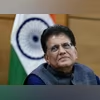
Commerce and Industry Minister Piyush Goyal said he is “assured” that India's stance on issues in the WTO was not only heard but also reflected in the ministerial decisions.
“India ensured that the voice of the Global South was well-articulated and the needs and aspirations of developing countries and Least Developed Countries (LDCs) were given primacy in the negotiating room,” the minister said on social media, adding that New Delhi constructively engaged in all agenda items and in areas where it had strong concerns. “On the sidelines of MC14, I held extensive bilateral meetings with many countries, trading blocs, and key African countries. This enabled greater receptiveness to India's position on key agenda items of MC14,” he added.
Delhi-based think tank GTRI said the outcome makes MC14 one of the most inconclusive ministerials in recent years, highlighting deep divisions over the future of the multilateral trading system.
“MC14 marks a turning point for the WTO — not because it failed to deliver new deals, but because it failed to preserve existing ones. The lapse of the e-commerce moratorium and TRIPS safeguard signals a deeper institutional drift, with old compromises breaking down. The divide is now structural: between those pushing coalition-driven rule-making and those defending consensus and policy space,” it said.


 "Piyush Goyal, Piyush")