


As Bangladesh reinvents itself, Islamist extremists see an opening
Demonstrators at a rally in Dhaka, the capital, warned that if the government did not give the death penalty to anyone who disrespected Islam, they would carry out executions with their own hands
 "Islam women extremism")
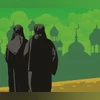
The fundamentalist turn has been especially distressing for female students who helped oust the country’s repressive prime minister, Sheikh Hasina. | ILLUSTRATION: BINAY SINHA
Listen to This Article
Mujib Mashal & Saif Hasnat
In the political vacuum that has emerged after the overthrow of Bangladesh’s authoritarian leader, religious fundamentalists in one town declared that young women could no longer play soccer. In another, they forced the police to free a man who had harassed a woman for not covering her hair in public, then draped him in garlands of flowers.
More brazen calls followed. Demonstrators at a rally in Dhaka, the capital, warned that if the government did not give the death penalty to anyone who disrespected Islam, they would carry out executions with their own hands. Days later, an outlawed group held a large march demanding an Islamic caliphate.
As Bangladesh tries to rebuild its democracy and chart a new future for its 175 million people, a streak of Islamist extremism that had long lurked beneath the country’s secular facade is bubbling to the surface.
In interviews, representatives of several Islamist parties and organizations — some of which had previously been banned — made clear that they were working to push Bangladesh in a more fundamentalist direction, a shift that has been little noticed outside the country.
Also Read

 "Sheikh Hasina")
 "Himanta Biswa Sarma, Himanta Biswa, Himanta")
 "Muhammad Yunus, Yunus")
 "Bangladesh Protest")
 "Yunus, Muhammad Yunus")
The Islamist leaders are insisting that Bangladesh erect an “Islamic government” that punishes those who disrespect Islam and enforces “modesty” — vague concepts that in other places have given way to vigilantism or theocratic rule.
Officials across the political spectrum who are drafting a new Constitution acknowledged that the document was likely to drop secularism as a defining characteristic of Bangladesh, replacing it with pluralism and redrawing the country along more religious lines.
The fundamentalist turn has been especially distressing for female students who helped oust the country’s repressive prime minister, Sheikh Hasina.
They had hoped to replace her one-party rule with a democratic openness that accommodates the country’s diversity. But now they find themselves competing against a religious populism that leaves women and religious minorities, including Hindus and adherents of small sects of Islam, particularly vulnerable.
“We were at the forefront of the protests. We protected our brothers on the street,” said Sheikh Tasnim Afroz Emi, 29, a sociology graduate from Dhaka University. “Now after five, six months, the whole thing turned around.”
Critics say the country’s interim government, led by the 84-year-old Nobel laureate Muhammad Yunus, has not pushed back hard enough against extremist forces. They accuse Yunus of being soft, lost in the weeds of democratic reforms, conflict-averse and unable to articulate a clear vision as extremists take up more public space. His lieutenants describe a delicate balancing act: They must protect the right to free speech and protest, but doing so provides an opening for extremist demands.
The police, who largely deserted after Hasina’s fall and remain demoralised, can no longer hold the line. The military, which has taken up some policing duties, is increasingly at odds with the interim government and the student movement, which wants to hold officers accountable for past atrocities.
What is beginning to happen in Bangladesh mirrors a wave of fundamentalism that has consumed the region. Afghanistan has become an extreme ethno-religious state, depriving women of the most basic liberties. In Pakistan, Islamist extremists have exerted their will through violence for years. In India, an entrenched Hindu right wing has undermined the country’s traditions of secular democracy. Myanmar is gripped by Buddhist extremists overseeing a campaign of ethnic cleansing.
Nahid Islam, a student leader who was a government minister in Bangladesh’s interim administration before stepping away recently to lead a new political party, acknowledged “the fear is there” that the country will slip toward extremism.
But he is hopeful that despite changes in the Constitution, values like democracy, cultural diversity and an aversion to religious extremism can hold. “I don’t think a state can be built in Bangladesh that goes against those fundamental values,” he said. Some point to a Bengali culture with a deep tradition of art and intellectual debate. Others find hope in the shape of the country’s economy.
Women are so integrated in Bangladesh’s economy — 37 percent are in the formal labour force, one of the highest rates in South Asia — that any efforts to force them back into the home could result in a backlash.
Extremist forces are trying to push their way into the picture after 15 years in which Hasina both suppressed and appeased them.
With Hasina gone, smaller extremist outfits that want to upend the system entirely, and more mainstream Islamist parties that want to work within the democratic system, appear to be converging on a shared goal of a more conservative Bangladesh.
More From This Section
 "Vijay Sharma, Vijay")
 "Muhammad Yunus, Prime Minister Narendra Modi, PM Modi")
 "INS Teg, Talwar-class frigate, Indian Navy")
 "Andaman and Nicobar")
 "BIMSTEC, Modi, Narendra Modi")
Topics : Bangladesh Muhammad Yunus Islam Dhaka
Don't miss the most important news and views of the day. Get them on our Telegram channel
First Published: Apr 02 2025 | 10:50 PM IST