


Trump admin to award women student leaders from Bangladesh protests
The Bangladeshi women will be receiving the 'Madeleine Albright Honorary Group Award'. The names of the individual honourees have not been disclosed by the US State Department
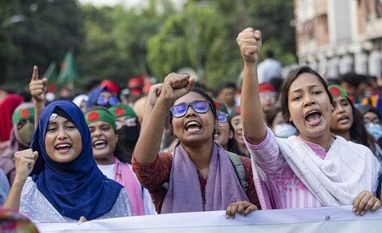 "Bangladesh Protest")
Students shout slogans during a protest demanding the trial of former Prime Minister Sheikh Hasina in Dhaka, Bangladesh, Tuesday, Aug. 13, 2024. (Photo: PTI)


Listen to This Article
A group of Bangladeshi women student leaders, who played a key role in last year’s protests against the Sheikh Hasina government, will be among the recipients of the International Women of Courage (IWOC) Award, an annual honour bestowed by the US State Department, for their bravery and leadership.
"A valiant group of women were key drivers in the student protest movement against violent repression in Bangladesh in July-August 2024. They demonstrated extraordinary bravery, including standing between security forces and male protesters in spite of threats and violence," the department said in a statement on Friday.
"When male counterparts were arrested, these women found innovative ways to continue communication and lead the protests, defying censorship efforts, even during the complete shutdown of the internet. The bravery and selflessness of these women amid uncertainty was the very definition of courage," it said.
The US State Department has not disclosed the names of the honourees who will be receiving the award.
What is the IWOC award?
The IWOC Award, now in its 19th year, recognises extraordinary women from around the world who have demonstrated exceptional courage, strength, and leadership, often at great personal risk. Since its launch in 2007, over 200 women from more than 90 countries have been honoured.
Also Read

 "Yunus, Muhammad Yunus")
 "Sheikh Hasina")
 "China's President Xi Jinping")
 "Muhammad Yunus, Yunus")
 "Adani, Gautam Adani")
US Secretary of State Marco Rubio and First Lady Melania Trump will host the award ceremony at the Department of State on Tuesday, where these women will be presented with the 'Madeleine Albright Honorary Group Award', named in tribute to the first female US Secretary of State.
Bangladesh anti-Hasina student protest
Bangladesh witnessed a historic political shift in 2024 after weeks of student-led demonstrations culminated in the resignation and exile of long-standing Prime Minister Sheikh Hasina. The demonstrations, which began in early July, were driven by university students opposing a quota system that reserved 56 per cent of government jobs for specific groups, including 30 per cent for the descendants of those who fought in the 1971 War of Independence.
As the protests grew in intensity, the country was gripped by violent clashes, resulting in over 300 deaths. Sheikh Hasina responded with measures, including intermittent internet blackouts and a nationwide curfew, branding protesters as “terrorists” intent on destabilising the nation. The unrest reached its peak when demonstrators stormed Hasina’s official residence in Dhaka, prompting her to flee to India on August 5.
Following her departure, an interim government was established on August 8 under the leadership of Nobel Laureate Muhammad Yunus. Despite the transition, tensions remained high, with violence continuing in certain regions. India, in particular, condemned attacks on the Hindu community in Chittagong on November 6, warning that such incidents could exacerbate communal tensions.
In November, under the Biden administration, the United States expressed strong opposition to government-led crackdowns on peaceful demonstrations. By December, American lawmakers were calling for sanctions against Bangladesh over human rights violations, particularly concerning minority groups. However, after Donald Trump assumed office in 2025, US policy took a different turn, with reports suggesting Washington was considering selling millions of dollars' worth of military equipment to Bangladesh, even as aid to the country was frozen.
Meanwhile, the political landscape within Bangladesh is also evolving with many calling for elections in the country. In February 2025, student leaders, instrumental in Hasina’s ousting, announced the formation of a new political party, Ganatantrik Chhatra Sangsad (Democratic Student Council). The group, which includes key figures from the Students Against Discrimination (SAD) movement, is expected to contest future elections. However, divisions within the student movement have emerged, with some SAD leaders, including those involved in the interim government, preparing to launch a separate party, highlighting the complexities of Bangladesh’s post-Hasina political era.
More From This Section
 "Syria new cabinet")
 "US President Donald Trump")
 "Giorgia Meloni, Zelenskyy")
 "Giorgia Meloni")
 "Elon Musk, Musk")
Don't miss the most important news and views of the day. Get them on our Telegram channel
First Published: Mar 31 2025 | 1:07 PM IST