


Rajnath Singh stresses border management to Chinese counterpart at SCO meet
Rajnath Singh tells China a structured and permanent engagement is key to resolving border issues, while also flagging the Pahalgam attack at the SCO defence ministers' meet
 "rajnath singh, general don jun")
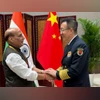
Defence Minister Rajnath Singh met Chinese counterpart Admiral Dong Jun in Qingdao, China, on the sidelines of the defence ministers’ meeting of the Shanghai Cooperation Organisation (SCO). (Photo: ANI)
Listen to This Article
Defence Minister Rajnath Singh on Thursday told his Chinese counterpart Admiral Dong Jun that a structured road map of permanent engagement and de-escalation would help in solving complex India-China border issues, the Ministry of Defence (MoD) said in a media statement on Friday.
“Singh stressed on border management and having a permanent solution to border demarcation by rejuvenating the established mechanism on the issue,” the MoD statement said.
Singh met Dong in Qingdao, China, on the sidelines of the defence ministers’ meeting of the Shanghai Cooperation Organisation (SCO) on Thursday.In-depth discussions on the need to maintain peace and tranquillity along the Indo-China border were held during the bilateral meeting, the statement said. It added that Singh acknowledged the work being undertaken by both sides to bring back a “semblance of normalcy”. He emphasised the need to create “good neighbourly conditions” to achieve the best mutual benefits as well as to cooperate for stability in Asia and the world.
The defence minister urged to bridge the trust deficit created after the Galwan River valley standoff in 2020 by “taking action on the ground”.
ALSO READ: 'Condemn terror without bias', urges Rajnath Singh at SCO meet in China
At least 24 Indian and Chinese soldiers were killed in the clash that led to the freezing of bilateral relations, which have started thawing since Prime Minister Narendra Modi and Chinese President Xi Jinping met on the sidelines of a Brics summit in Russia in October.
Also Read

 "S Jaishankar, Jaishankar, Virendra Sachdeva")
 "Rajnath Singh, Defence Minister, SCO")
 "rajnath singh, general don jun")
 "Rajnath Singh")
 "Rajnath Singh")
The two ministers agreed to continue discussions at various levels to achieve progress on issues related to disengagement, de-escalation, border management, and “eventually delimitation through existing mechanisms”, the statement said.
Singh also briefed Dong on the Pahalgam terror attack, when 26 people were killed in a targeted manner, and on Operation Sindoor – India’s military campaign two weeks later against terrorist camps in Pakistan that India said were linked to the attack.
India refused to sign an intended SCO communique on Thursday because it didn’t include the Pahalgam terrorist attack, among other concerns.
Singh also met Russian Defence Minister Andrey Belousov in Qingdao, where they discussed the production of air defence items and air-to-air missiles, as well as the supply of Russian-made S-400 systems and Su-30MKI fighter jet upgrades.
India deployed the S-400 missile system, which is integrated with its indigenous platforms, effectively during the four-day conflict with Pakistan after Operation Sindoor was launched on May 7.
India is seeking to upgrade its Su-30MKI fleets, estimated to be 260. The process, according to government sources, will likely include upgrading avionics, radars, engines, electronic warfare equipment and weapons. It is one the most strategically significant fleets of the Indian Air Force and has been upgraded over the past decade or so.
ALSO READ: Why did Rajnath Singh refuse to sign SCO bloc communique in China?More From This Section
 "People who were evacuated from Iran under Operation Sindhu upon their arrival at Delhi airport")
 "Army, Soilder, Kathua")
 "jaishankar, aus FM Penny wong")
 "S Jaishankar, Jaishankar, S Jaishankar, Jaishankar, Muhammad bin Abdul Rahman, Abdul Rahman, Qatar PM")
 "Indian students returned back from Iran")
Don't miss the most important news and views of the day. Get them on our Telegram channel
First Published: Jun 27 2025 | 1:37 PM IST