


US, Japan announce major upgrade to defence alliance to counter China
US President Joe Biden and Japanese Prime Minister Fumio Kishida recently unveiled a historic upgrade of US-Japan defence ties amid China's growing assertiveness
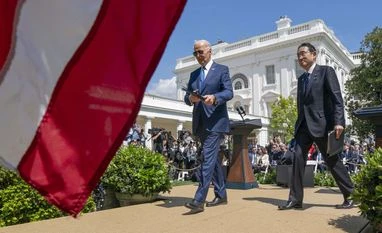 "President Joe Biden, left, and Japanese Prime Minister Fumio Kishida depart after a news conference in the Rose Garden of the White House, Wednesday, April 10, 2024, in Washington (AP/PTI)")
President Joe Biden, left, and Japanese Prime Minister Fumio Kishida depart after a news conference in the Rose Garden of the White House, Wednesday, April 10, 2024, in Washington (AP/PTI)
US President Joe Biden and Japanese Prime Minister Fumio Kishida announced a "new era" for their countries' alliance during a state visit to Washington by the latter on Wednesday, with the two leaders unveiling a historic upgrade of US-Japan defence ties amid China's growing assertiveness in the Indo-Pacific.
"Over the last three years, the partnership between Japan and the United States has been transformed into a truly global partnership," President Biden said ahead of talks with PM Kishida at the White House.
Biden and Kishida unveiled around 70 agreements, in what a White House official told The Japan Times was "the largest set of substantial, significant deliverables that we've seen" to date.
Biden described the revamped ties as "the most significant upgrade in our alliance since it was first established". At a press conference following the talks with Kishida, Biden underscored his push to "rebuild the muscle" of America's alliances, which the President called "America's greatest asset". However, he also insisted that the upgraded alliance was "purely defensive in nature".
The move comes amid rising concerns over China's military aggression around Taiwan and North Korea's saber-rattling.
Also Read

Pledging to push US-Japan ties even closer, Biden and Kishida unveiled plans to revamp the US military's command and control framework in Japan "to enable seamless integration of operations and capabilities and allow for greater interoperability and planning between US and Japanese forces." The Japan Self-Defense Forces would be undertaking a similar move.
Talks on this revamp will be fleshed out at the 'two-plus-two' talks between the US and Japan's defence chiefs and top diplomats, with a meeting expected to take place in coming months.
"More effective US-Japan Alliance command and control will strengthen deterrence and promote a free and open Indo-Pacific in the face of pressing regional security challenges," said the US-Japan joint leaders' statement.
The new agreements also include a deal that will allow Japanese companies to handle major repairs for US Navy warships. The two leaders said in their joint statement that the US and Japan also "plan to explore the possibility of conducting maintenance and repair on engines of Japan-based US Air Force aircraft, including fourth generation fighters."
The US and Japan also announced that they would set up a new consultative body "to leverage our respective industrial bases to meet the demand for critical capabilities and maintain readiness over the long term". The Defence Industrial Cooperation, Acquisition and Sustainment (DICAS) forum, which is jointly led by the Japanese Defence Ministry and the Pentagon, would use this "to identify priority areas for partnering US and Japanese industry" on military equipment.
The two leaders also announced plans to upgrade defence communications networks. To counter air and missile threats, Biden and Kishida unveiled plans to network air defence capabilities between the US, Japan and Australia.
The US-Japan joint leaders' statement also said that the Treaty of Mutual Cooperation and Security, which ensures bilateral defence and security cooperation between the two countries, was "stronger than ever". The two sides affirmed that their alliance "remains the cornerstone of peace, security, and prosperity in the Indo-Pacific". Biden also reiterated the "unwavering commitment" of the US "to the defence of Japan under Article V of the Treaty, using its full range of capabilities, including nuclear capabilities".
Biden also reaffirmed that Article V applies to the Senkaku Islands. The joint statement said, "We reiterated our strong opposition to any attempts by the People’s Republic of China (PRC) to unilaterally change the status quo by force or coercion in the East China Sea, including through actions that seek to undermine Japan's longstanding and peaceful administration of the Senkaku Islands."
The two leaders also resolved to increase bilateral cooperation "toward the effective development and employment of Japan's suite of counterstrike capabilities, including the provision of US materiel and technological support to enhance Japan's indigenous stand-off programmes."
Japan adopted security policies in December 2022 that stressed the importance of "counterstrike capabilities" and laid out a plan to develop standoff missiles. In case of missile strikes against it, the Japanese government says that these capabilities will enable Tokyo to mount effective counterstrikes in order to prevent further attacks, even as Japan's missile defence network defends against the incoming missiles. They will also enable Tokyo to mount counterstrikes against an opponent's territory in case of an armed attack against Japan where ballistic missiles or other means are used.
The US said it was committed to start the training and ship modifications necessary for Japan to acquire the Tomahawk Land Attack Missile system's operational capabilities.
The two leaders also reaffirmed the US and Japan's pursuit of "a Glide Phase Interceptor (GPI) cooperative development programme to counter high-end, regional hypersonic threats". A bilateral collaboration on "a Low Earth Orbit detection and tracking constellation for missiles such as hypersonic glide vehicles" was also announced, including potential collaboration with US industry on the same.
The GPI programme will likely create capabilities aimed at knocking down hypersonic missiles during their glide phase of flight, when the projectile is skimming outer space and before it reenters the atmosphere.
As part of the NASA-led Artemis mission, Biden and Kishida also announced a goal of making a Japanese national the first non-American to land on the Moon.
The bolstered ties come at a time when Japan's defence policy has undergone a dramatic change, including a commitment to increase military spending to 2 per cent of gross domestic product by 2027 and the easing of stringent defence export guidelines.
Biden and Kishida also said that "as the Indo-Pacific and Euro-Atlantic regions become ever more interlinked", new and regular US-Japan-UK trilateral military exercises would commence in 2025.
Before Wednesday's developments, the US, UK and Australia on Monday announced that they were considering cooperating with Japan on advanced technology projects under the trilateral AUKUS security pact, which is meant to provide deterrence against China in the Indo-Pacific.
Defence ministers from AUKUS-member nations said that they would consider bringing Japan into the security pact's Pillar-II, which focuses on developing advanced technologies like hypersonic weapons, undersea capabilities, quantum computing, and artificial intelligence.
The US will also add one more minilateral grouping of allies and partners to its arsenal, when President Biden will host Japanese PM Kishida and Philippine President Ferdinand Marcos Jr in Washington on April 11 for the first US-Japan-Philippines trilateral summit. According to Nikkei Asia, the summit will aim to address China's 'gray zone' tactics, among other things.
More From This Section
Topics : Joe Biden defence deals Japan Indo-Pacific
Don't miss the most important news and views of the day. Get them on our Telegram channel
First Published: Apr 11 2024 | 4:23 PM IST