


Ensured minimum disturbance while building Chenab, Anji bridges: LS told
Talking about its social significance, Vaishnaw stated that the USBRL project has made substantial socio-economic contributions to the region
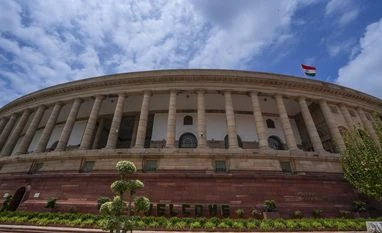 "Parliament, New Parliament, Lok sabha, Rajya sabha")
To ensure minimum disturbance to Himalayan ecology, due care has been taken for slope stabilisation. (Photo: PTI)
Listen to This Article
To ensure minimum disturbance to Himalayan ecology, due care was taken for slope stabilisation and the best institutes were roped in for execution of the Udhampur-Srinagar-Baramulla Rail Link, including Chenab and Anji Bridge, the Lok Sabha was informed on Wednesday.
On questions whether the government has conducted any environmental impact assessments of the Chenab and Anji Khad bridges in fragile Himalayan zones, the Railway Minister Ashwini Vaishnaw provided an elaborate response on Environmental Impact Assessments of the project.
Vaishnaw said that Udhampur-Srinagar-Baramulla Rail Link (USBRL) project having a total length of 272 km has been recently commissioned and it covers Jammu and Kashmir's Udhampur, Reasi, Ramban, Srinagar, Anantnag, Pulwama, Budgam and Baramulla districts.
The USBRL project is one of the most difficult new railway line projects undertaken in the country post-independence. The terrain passes through young Himalayas, which are full of geological surprises and numerous problems, he said.
The minister added that in this project, the Indian Railways have made the world's highest Rail Bridge over Chenab river in Reasi district of Jammu and Kashmir.
Also Read

 "Supreme Court, SC")
 "Insolvency and Bankruptcy Board of India, IBBI")
 "Supreme Court, SC")
The iconic Chenab Bridge is 1,315 meters long having an arch span of 467 meters and height of 359 meters above river bed. Indian Railway's first cable-stayed bridge has been constructed over Anji Khad in this project. Its bridge deck is 331 meters above the river bed level and height of its Main pylon is 193 meters, he informed the Lok Sabha.
Talking about its social significance, Vaishnaw stated that the USBRL project has made substantial socio-economic contributions to the region, with employment generation being a significant aspect of its impact as the project has generated more than 5 crore man-days of employment.
To ensure minimum disturbance to Himalayan ecology, due care has been taken for slope stabilisation and the best institutes of the world were roped in for execution of this project. Comprehensive schemes for slope stabilisation have been adopted as per NEERI guidelines and Detailed Design Consultants' suggestions to prevent erosion and damage to natural terrains, Vaishnaw said.
He added, Slope stability at Chenab Bridge was designed by Indian Institute of Science, Bangalore & IIT/Delhi.
Other global firms having experience of such works were also engaged for independent check for slope stability for Chenab Bridge. Slope stability at Anji Bridge was also designed and proof checked by experienced global firms, the Railway minister said.
Outlining the project's environmental measures, he said, Further, Environmental Impact Assessments due to construction of Katra-Qazigund new rail line, including Chenab and Anji Khad bridges have also been conducted through National Environmental Engineering Research Institute (NEERI), Nagpur.
Extensive safeguards and mitigation measures have been implemented based on the Environmental Management Plan (EMP) prepared by NEERI, he said.
Sedimentation tanks have been constructed at tunnel outlets before discharging into natural nallas to manage tunnel excavated material. Alternative water sources were provided to villages where natural sources were disrupted by resorting to reverse pumping, Vaishnaw said.
Proper lined drains and stepped chutes were constructed at required locations to ensure smooth flow of surface water and prevent erosion at muck yards, he added.
According to the Railway Minister, advanced techniques of controlled blasting were adopted during tunnelling to minimize vibrations and environmental damage.
Sensors have been installed in all tunnels in the Katra-Banihal section to monitor the Air Quality during the operational phase also, he said.
The entire rail project is electrified using an overhead conductor system in tunnels and in open stretches. Rail transportation is the most environment friendly transportation mode, significantly reducing carbon footprint compared to diesel traction, he added.
He also highlighted that the specific measures for biodiversity conservation are delineated in the EMP, the overall environmental mitigation efforts contribute to protecting local ecology.
Guidelines for site preparation for plantation activity on dumping sites include planting native species and turfing with grass for eco-restoration, Vaishnaw said.
(Only the headline and picture of this report may have been reworked by the Business Standard staff; the rest of the content is auto-generated from a syndicated feed.)
More From This Section
 "Mithun Chakraborty, Mithun")
 "Uttarakhand Flood, Flood")
 "Rajat Kanta Ray")
 "Pushkar Singh Dhami, Uttarakhand CM")
 "Prime Minister Narendra Modi")
Don't miss the most important news and views of the day. Get them on our Telegram channel
First Published: Aug 07 2025 | 6:47 AM IST