


Sustained rise in labour productivity crucial for Viksit Bharat: NITI V-C
Industry should welcome Trump tariffs like it did 1991 reforms, says Suman Bery
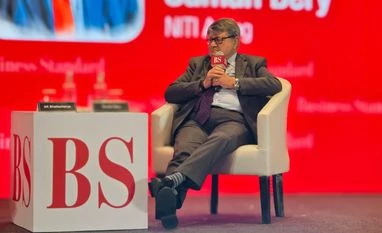 "US is protective about its top dog position, Suman Bery, vice chairperson, NITI Aayog said.")
The Niti VC, who has been advocating for increasing labour productivity amid a larger government agenda to improve the employment generation in the country, said that India’s labour force is thrice that of the US.
Listen to This Article
Citing that India’s labour productivity is lowest among G20 nations, NITI Aayog Vice-Chairman Suman Bery on Thursday said increasing productivity of labour was crucial as India advances towards its ambitious target of becoming a $30-trillion economy by 2047.
“A sustained rise in the productivity of labour is crucial. In the next 5-10 years, it’s a horse race between two forces – an increase in labour productivity and the fact that we need to absorb additional hands, and that is the reason why we need to grow faster,” Bery said at Confederation of Indian Industry’s (CII) Annual Business Summit here.
India’s two most underutilised labour demographics are its women and youth, he said.
Bery also said the growth in productivity for India’s labour force has not been fast enough for the aspirations of its people.
“We are seeing certain pathologies – rising labour productivity is leading to faster growth in real incomes. The fact that it has not been happening as fast as people’s aspirations is what is leading to the queueing for government jobs,” Bery said.
Also Read

 "NITI Aayog Vice-Chairman Suman Bery")
 "Education loan")
 "digital infrastructure, Cyberattacks, Pahalgam attack, terrorist attacks, central government, Meity")
 "military budget, defence budget, army budget, army weapons")
 "IPL 2025 Qualifier 1 highlights")
The NITI Aayog V-C, who has been advocating for increasing labour productivity amid a larger government agenda to improve the employment generation in the country, said that India’s labour force is thrice that of the US.
“India’s track record has not been bad in terms of growth productivity, but it needs to get better. Our problem is our low level of labour productivity, not only with respect to the US but also with respect to some of our peers, such as China and other peers in Asean,” he said.
He expressed the need to diversify the sources of employment in the country.
“About 44 per cent of our population is still in agriculture. If we can move labour from agriculture into high-value services or manufacturing, there will be an increase in productivity in agriculture and will also result in an increase in the productivity of the labour force that moves to manufacturing and services,” he said.
“This transition has been slower in India than certain of our peers, and it is certainly something that NITI is working on,” he added.
On Trump tariffs, Bery said the current situation shows that India would need to reciprocate if it wants access to external markets.
“Indian industry is now confident enough. If it welcomed liberalisation in 1991, it is certainly strong enough to welcome judicious liberalisation in 2025 and the coming decade,” Bery said.
He said a part of the onus of economic reform in pursuit of Viksit Bharat lies with states.
“The PM said the central government can create the conditions through FTAs, BITs, and review of QCOs. But in the end, it’s up to states to harness opportunities,” Bery said on the deliberations at the recently concluded governing council meeting of the Aayog, which is chaired by the PM and attended by heads of all states.
More From This Section
 "Delhi Mock Drill, Mock Drill, Drill")
 "Pollution, New Delhi Pollution, Water Pollution, Yamuna, Delhi Yamuna")
 "Thunderstorm, New Delhi Thunderstorm")
 "Narendra Modi (Photo: X@narendramodi)")
 "Supreme Court, SC")
Topics : NITI labour Law Labourer
Don't miss the most important news and views of the day. Get them on our Telegram channel
First Published: May 29 2025 | 10:41 PM IST