


PM Modi likely to secure deal for E10 bullet trains during Japan visit
The E10 Shinkansen high-speed train project is expected to form part of a new transport and mobility partnership between India and Japan
 "PM Modi")
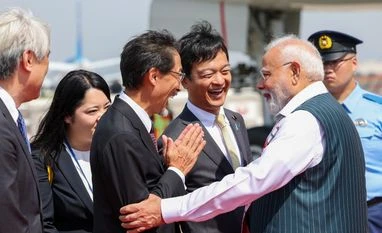
Prime Minister Narendra Modi has reached Tokyo, where he is scheduled to meet Prime Minister of Japan Shigeru Ishiba to deepen the existing partnership, and explore possibilities for new cooperation. (Image: X@narendramodi)
Listen to This Article
Prime Minister Narendra Modi will meet his Japanese counterpart, Shigeru Ishiba, on Friday at the 15th India-Japan annual summit. This will be PM Modi’s first solo visit to Japan in nearly seven years and his first meeting with Ishiba. The discussions are expected to cover a wide range of sectors, including infrastructure, energy, defence, security, trade, economy, technology, and innovation.
E10 Shinkansen bullet trains to come to India
A key highlight of the summit is the anticipated announcement of a partnership to manufacture the next-generation E10 Shinkansen bullet trains in India. The E10 Shinkansen project is expected to form part of a new transport and mobility partnership between India and Japan. The two leaders are also scheduled to visit the Tohoku Shinkansen plant in Sendai to observe the production of bullet train coaches.
Earlier this year, Tokyo confirmed that India and Japan will launch the latest E10 Shinkansen simultaneously. India was initially set to receive the older E5 model, but PM Modi’s strong push for the project and close ties with Japanese leaders helped secure the newer version, reported Financial Express. The E10 series is currently undergoing tests in Japan, with operations expected to begin in 2030.
Also read: E10 bullet train to debut in India and Japan simultaneously in 2030
Key features of Shinkansen E10 series
- Can reach speeds of up to 400 kmph
- Earthquake-resistant design for enhanced safety
- Equipped with advanced safety systems
- Uses ALFA-X train as a testing platform in Japan
Here are other key areas expected to feature in the summit discussions:
Expanding high-speed rail network in India
High-speed rail will be another key topic at the summit, with discussions expected to focus on extending the Mumbai-Ahmedabad bullet train project to additional routes across India.
Focus on semiconductors and electronics
The summit will also address semiconductor and electronics manufacturing. PM Modi and Ishiba are set to tour the Tokyo Electron Factory, a leading chipmaking company. Japan plans to invest heavily in semiconductors and artificial intelligence over the next decade, collaborating with Indian talent and firms to strengthen supply chains and secure critical minerals.
Image: X@narendramodi
Advancing AI and digital partnerships
Artificial intelligence is another major area of focus. Both countries are expected to launch a joint initiative to develop AI tools, support startups, and share expertise to expand digital infrastructure. Other discussions may cover telecom technologies and clean energy innovations to further grow India’s digital economy.
Defence and security cooperation
Defence and security will also feature prominently in the talks. The ‘Unicorn’ radar and communication project is expected to progress, enhancing India’s naval capabilities. The two nations may collaborate on ship maintenance and jointly develop defence equipment. The 2008 security agreement is likely to be upgraded, with a focus on cybersecurity and maritime security.
Economic and investment partnerships
India and Japan are expected to upgrade their 2008 Joint Declaration on Security Cooperation and launch a new economic security initiative covering semiconductors, critical minerals, AI, telecom, and clean energy. Both countries see this as a cornerstone for strengthening economic, scientific, and technological ties.
The leaders will also push for increased Japanese investments in India. The previous target of 5 trillion yen in public and private investments by 2026 has already been achieved in 2025. Discussions are likely to raise the new target to 7–10 trillion yen.
Bilateral space collaboration
Space initiatives will be part of the agenda as well. India’s Isro and Japan’s Jaxa are set to continue collaboration on the Lunar Polar Exploration Mission (Lupex), linked to Chandrayaan-5. The project may create opportunities for Indian startups to leverage Japanese technology for future space missions.
More From This Section

 "cloudburst, Himachal cloudburst")
 "Urjit Patel")
 "Microsoft logo, Microsoft")
 "Supreme Court, SC")
 "Rahul Gandhi, Rahul, Congress leader")
Don't miss the most important news and views of the day. Get them on our Telegram channel
First Published: Aug 29 2025 | 10:14 AM IST