


Explained: Why India's 2027 emission target has automakers on edge
India wants to cut vehicle emissions by 33 per cent by 2027, but carmakers say the targets are too steep, too soon, and could hurt jobs, raise prices, and stall the industry's green transition
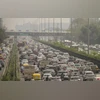 "Gurugram Traffic, Traffic jam")
For Indian consumers, this regulatory shift could mean higher prices, particularly for entry-level cars (Photo: PTI)
Listen to This Article
India sets ambitious 2027 emission target
India wants its cars to breathe cleaner by 2027. To that end, the Centre has proposed slashing average carbon dioxide (CO₂) emissions by 33 per cent. As one of the world’s largest greenhouse gas emitters, and with a $137-billion auto sector playing a key role, the push for greener alternatives is gaining urgency.
But automakers aren’t fully on board. Under the new fuel efficiency standards—Corporate Average Fuel Efficiency (CAFE-III)—scheduled to take effect on April 1, 2027, manufacturers must lower average carbon emissions to 91.7 grams per kilometre (g/km), from the current 113.1 g/km.
While the government frames this as a vital climate commitment, the auto industry warns that the timeline is too narrow and the targets too aggressive—risking an adversarial policy clash.
Also Read

 "US visa, H4, H1B")
 "Donald Trump, Trump, Ursula von der Leyen, Ursula, von der Leyen, Leyen")
 "Drone")
 "Google DeepMind CEO Demis Hassabis")
 "Hyper-realistic reborn dolls")
What the government aims to achieve
The Centre’s proposal, while straightforward on paper, is complex in practice. The Ministry of Road Transport and Highways aims to implement the third phase of CAFE standards by 2027, aligned with the globally recognised WLTP (Worldwide Harmonised Light Vehicles Test Procedure) protocol—considered more realistic than India’s older MIDC testing model.
Officials insist this move is essential. With transport contributing over 10 per cent of total emissions, the government believes tighter norms will accelerate innovation and electric vehicle (EV) adoption.
Why India’s carmakers are concerned
For manufacturers, the challenge is as much economic as it is technological. Carmakers say that achieving a 33 per cent reduction within three years will require a drastic overhaul of production systems, powertrains, and portfolios—demands they argue are neither time- nor cost-feasible.
Maruti Suzuki has asked for relaxed norms for sub-1,000kg vehicles to shield models like Alto and WagonR. Meanwhile, Tata, Mahindra, Hyundai, Toyota, Renault, Honda, and Kia oppose any weight-based exemption, citing competitive distortion. Toyota is also pushing for greater hybrid incentives.
Falling short of targets could trigger steep penalties. Given high input costs and a recovering post-pandemic market, several firms fear profit erosion. Worries also extend to downstream impacts—possible job losses, price hikes, and reduced availability of budget vehicles.
What it means for Indian car buyers
For Indian consumers, this regulatory shift could mean higher prices, particularly for entry-level cars. If automakers divert resources toward lower-emission or higher-margin vehicles, affordability could take a hit.
On the upside, stricter norms could spur faster investment in EVs, hybrids, and clean-fuel tech—potentially improving air quality and expanding green vehicle options. But whether these advances remain accessible to the mass market remains uncertain.
What automakers are proposing instead
Industry groups are urging a phased approach, starting with a 15 per cent emissions cut. The Society of Indian Automobile Manufacturers (SIAM) has formally petitioned the government to reconsider targets set under ENVISION 2030.
Citing gaps in fuel quality, charging infrastructure, and supply chain readiness—especially for hybrid and EV platforms—automakers argue that a gradual transition will better serve India’s dual goals of climate leadership and industrial growth.
Why lighter vehicles face fewer hurdles—and more debate
CAFE-III targets vary based on vehicle weight. Lighter vehicles are expected to meet lower emission targets than heavier ones, triggering tension among manufacturers.
Some large-volume carmakers argue this favours lightweight players and could disincentivise innovation in premium segments—already burdened by electrification and safety compliance costs.
Hybrids, ethanol cars and the ‘green credit’ tug-of-war
A parallel debate surrounds which technologies deserve green credits. While EVs receive favourable offsets in fleet emission calculations, the industry wants similar recognition for hybrids, CNG vehicles, and ethanol-blended fuel cars.
Many automakers argue that in a country with limited charging infrastructure, hybrids and ethanol vehicles offer a more realistic green pathway. The government has yet to clarify how these alternatives will be accounted for under CAFE-III.
Is an ICE ban looming by 2040?
Adding to the anxiety is talk of a 2040 phaseout of internal combustion engine (ICE) vehicles. While not yet policy, the possibility has emerged in several government forums.
Automakers caution that such signalling could deter near-term investments in ICE upgrades still critical for rural and semi-urban markets. Without incentives or a concrete roadmap, supply chains could be disrupted and consumers left uncertain.
The road ahead
The government wants cleaner air and global credibility on climate action. The auto industry is asking for more time, clearer rules, and infrastructure support. What emerges from this policy standoff will shape not just India’s car market—but the nation’s mobility future.
More From This Section
 "BYD")
 "auto, automakers, auto companies")
 "In growth lane: Exports of passenger vehicles, 2-wheelers surge in 2024")
 "Cars, auto industry")
 "Shailesh Chandra")
Topics : Decoded Emission norms automobile industry Automakers automobile manufacturer BS Web Reports
Don't miss the most important news and views of the day. Get them on our Telegram channel
First Published: Jul 29 2025 | 11:19 AM IST