


India core to global automakers' plans, but EV adoption still slow: Moody's
Moody's sees India's car sales growing at Asia's fastest rate, but says EV transition faces challenges due to limited infrastructure and cost pressures
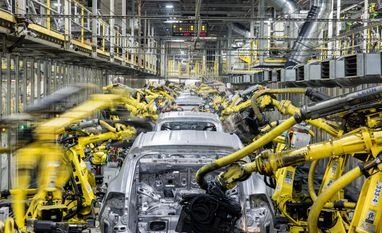 "car manufacturing, cars, auto industry")
Image: Bloomberg
Listen to This Article
India will remain central to global automakers’ strategies in the coming years, driven by a young and growing working-age population and rising incomes, Moody’s Ratings said in a new report on Tuesday. However, the global credit ratings agency also noted that India’s transition to electric vehicles (EVs) will be gradual, with infrastructure gaps and supply chain hurdles slowing adoption. Moody’s expects India’s car sales to grow at a compound annual growth rate of 3.5 per cent—the highest in Asia—reaching around 5.1 million units by 2030. “A low car penetration rate of only 44 cars per 1,000 people underlines the significant growth potential in India, which is already the world’s third-largest auto market by unit sales,” the report noted.
Intense competition, diverse players
India’s car market remains fiercely competitive, with domestic companies accounting for about a quarter of sales. Japanese, Korean and Chinese automakers—often through joint ventures or subsidiaries—dominate over 70 per cent of the market, leveraging their global product lineups to gain an edge.
Moody’s observed that India’s trade negotiations and a recent trade deal with the UK signal growing pressure to open up the domestic market, traditionally protected by high import tariffs.
EV growth faces infrastructure gaps
Despite strong demand, the country’s shift to EVs remains in early stages, with Tata Motors and Hyundai focusing on battery electric vehicles, while Honda plans to start with plug-in hybrids. Automakers are expected to invest over $10 billion through 2030 to build competitiveness in the EV segment, though these investments will weigh on their free cash flows.
Also Read

 "Indian actress, Triptii Dimri")
 "infra construction")
 "cryptocurrency, crypto")
 "Moto G85 5G smartphone")
 "Google Pixel 9")
“The pace of battery electric vehicle adoption hinges on the development of a robust ecosystem, including nationwide charging infrastructure and reliable domestic battery supply chains,” Moody’s said.
India remains core to global automakers
Automakers are under pressure to electrify their line-ups in China, Europe and the US to meet emission targets, but India’s high-growth conventional vehicle market remains a critical focus for global players. India also serves as an export base for some automakers, reinforcing its strategic importance despite the slow local EV adoption.
Moody’s said that while EV profitability will remain modest in most markets, India’s demographic dividend and consumption growth will continue to underpin demand for conventional vehicles.
More From This Section
 "Volvo")
 "Nissan")
 "Electric buses, e-buses, e-bus, JBM Auto")
 "auto sector, passenger vehicles")
 "The MINI range registered sales of 150 units in Q1 2025 and 709 units in 2024 in India (File Photo)")
Don't miss the most important news and views of the day. Get them on our Telegram channel
First Published: May 27 2025 | 11:35 AM IST