Wednesday, February 18, 2026 | 12:19 PM ISTहिंदी में पढें
Home / Opinion / Columns / Now, for an investment protection guarantee to signal India is serious
Now, for an investment protection guarantee to signal India is serious
It will signal to the world that India is serious about being open for business
premium
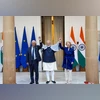
Prime Minister Narendra Modi with European Council President Antonio Costa, left, and European Commission President Ursula von der Leyen, right, during their meeting at the Hyderabad House, in New Delhi, Tuesday, Jan. 27, 2026. (PTI Photo/Salman Ali)
4 min read Last Updated : Jan 28 2026 | 10:30 PM IST
Listen to This Article
Prime Minister Narendra Modi may have correctly declined to acknowledge US president Donald Trump’s claims of ending war between India and Pakistan during Operation Sindoor. He may, however, have the maverick leader to thank for concluding the “mother of all free trade agreements” between India and the European Union (EU). This free trade agreement (FTA) opens European markets to Indian exports and Indian professionals and students in such a capacious manner that you wonder why it took two decades of shadow-boxing for the deal — it has a way to go before becoming a formal agreement — to be inked.
Mr Trump undoubtedly concentrated minds among vacillators on both sides of the Suez. Had he not virtually repudiated his nation’s commitment to Europe and the North Atlantic Treaty Organization (Nato) with his ambitions for Greenland at Davos, Brussels may not have suddenly understood the merits of aligning with a middle power that also faces exclusion from the American market for mostly spurious reasons. Though, as commentators have pointed out, the deal can hardly be considered a handy substitute for an India-US FTA, it does, together with the defence and stability pact, offer good news in terms of geopolitical signalling and market access. The bloc remains India’s largest trading partner for goods and one in which the country enjoys a trade surplus.
In reality, however, the optics are somewhat overplayed; the FTA and the defence and security partnership amount to half the work that’s needed to be done for both countries to derive optimum benefit. Middle class consumers of media such as this newspaper may be looking forward to cheaper wine, whisky, chocolate and high-end cars. But the deeper question is how far this FTA can go towards galvanising the economy and generating the jobs India’s youth so desperately need.
Provided that the red tape enabling access to preferential tariffs is kept to a minimum, makers in employment-intensive sectors such as leather, chemicals, textiles and garments, toys, and gems and jewellery could well enjoy expanded markets in Europe.
For a meaningful momentum shift it is well recognised that India needs an exponential expansion in manufacturing. But the absence of a robust investment protection agreement that will encourage European firms to set up base in India to serve both domestic and global markets remains a point of concern. This agreement has been in the works since 2022, five years after India unilaterally terminated almost all its bilateral investment treaties.
Investment guarantees are becoming critical to foreign direct investment because of the demonstrably capricious nature of Indian policy-making and judicial pronouncements. Among others, arbitrarily imposed quality control orders, Vodafone’s travails in India, and most recently the Supreme Court’s ruling on Tiger Global are unlikely to allay investor apprehensions about the stability of investing in India. In fact, there has been no more effective demonstration of the lack of confidence in India’s “doing business” ecosystem than the Indian business community itself.
In contrast to the private sector’s investment ennui in India — in spite of repeated appeals by the Prime Minister and the finance minister — overseas merger and acquisition (M&A) activity by Indian firms has been steadily increasing. India’s outbound investments grew 68 per cent in FY25 over FY24 and merchant bankers see this trend sustaining into the coming financial year. Notably, not all of this money is headed for tax havens. Several of India’s blue chip names are either raising stakes in overseas subsidiaries or buying companies. Whether it is Tata Steel’s acquisition of the commercial vehicle business of Italy’s Iveco Group, Zydus Lifesciences’ majority stake in France-based Amplitude Surgical, Bharti Enterprises’ strategic investment in UK’s BT Group, or Aditya Birla Group’s plans to establish a manufacturing and research centre in Texas, these deals, though relatively modest, reflect Indian businesses’ aspirations to connect with global supply chains from which India has largely remained excluded.
An investment protection agreement would help alter this dynamic and complement the FTA and defence partnership by encouraging European corporations to consider the country as a viable geography to set base. More than anything, it would also signal to the world that India was serious about being open for business.
Disclaimer: These are personal views of the writer. They do not necessarily reflect the opinion of www.business-standard.com or the Business Standard newspaper


 "Prime Minister Narendra Modi with European Council President Antonio Costa, left, and European Commission President Ursula von der Leyen, right, during their meeting at the Hyderabad House, in New Delhi, Tuesday, Jan. 27, 2026. (PTI Photo/Salman Ali)")