


How much damage US strikes did on Iran's nuclear facilities: Satellite pics
The US used B-2 bombers, submarine-launched missiles and bunker-busting bombs to strike Fordow, Natanz and Isfahan in its largest combat operation targeting Iran's nuclear facilities
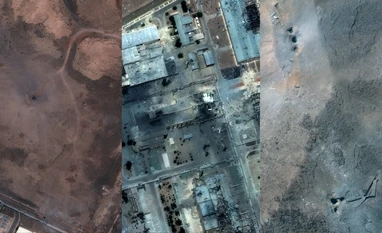 "Satellite image show damage done by US airstrikes over Iran nuclear facilities in Isfahan, Natanz, Fordow, Iran, nuclear facility")
Satellite image show damage done by US airstrikes over Iran nuclear facilities in Isfahan, Natanz, and Fordow
Listen to This Article
The United States carried out coordinated strikes on three of Iran’s most significant nuclear facilities: Fordow, Natanz and Isfahan on June 22. The operation, involving B-2 stealth bombers, submarine-launched cruise missiles and precision-guided munitions, was one of the most complex missions in recent US military history.
The Pentagon described the 25-minute window of strikes, executed between 2.10 am and 2.35 am Iran time, as the largest B-2 combat operation ever conducted.
President Donald Trump hailed the mission as “spectacularly successful”, claiming the sites were “totally obliterated.” Iranian officials disputed this, saying key facilities had been evacuated in advance and that nuclear activities would resume without interruption.
Also Read

 "Stock Market, Market, Crash, Funds, up, Stock, Lost, decline, statistic, Crisis, Capital, BSE, NSE")
 "Donald Trump, Trump")
 "operation midnight hammer")
 "pizza")
 "Strait of Hormuz")
Fordow: Deep-strike hits on hardened facility
The Fordow Fuel Enrichment Plant, buried deep within a mountain near Qom, was hit by at least 14 GBU-57 Massive Ordnance Penetrators, a 30,000lb “bunker busters” designed for hardened underground targets.
The strike was part of ‘Operation Midnight Hammer’ and executed by B-2 bombers flying under radio silence. Satellite imagery reviewed by Al Jazeera’s Sanad unit shows multiple impact craters and damage to nearby air defence systems.
Fordow had previously housed centrifuges capable of enriching uranium to weapons-grade levels. Iran maintains the facility was dedicated to peaceful research and had been under International Atomic Energy Agency (IAEA) supervision until recently.
A satellite view shows an overview of Fordow underground complex before (left) and after (right) the US struck the underground nuclear facility, near Qom, Iran June 22, 2025. | Photo: Reuters
A closer satellite view shows the tunnel entrances to Fordow underground complex, after the US struck the underground nuclear facility, near Qom, Iran June 22, 2025. | Photo: Reuters
Natanz: Disabling support systems
At Natanz, Iran’s largest enrichment complex, the US targeted above-ground infrastructure, including power distribution systems and support facilities. The site had already suffered damage in an Israeli airstrike on June 15.
Although the fortified underground cascade hall appears intact, disruption to power systems may have impaired centrifuge operations. The IAEA had previously confirmed enrichment at Natanz had reached 60 per cent purity, just short of the 90 per cent threshold for weapons-grade material.
Satellite image shows an overview of Natanz Enrichment Facility before (left) and after (right) it was hit by US airstrikes, near Natanz, Iran | Photo: Reuters
Satellite image shows a close up of a crater over the underground facility of Natanz Enrichment Facility, after it was hit by US airstrikes, near Natanz, Iran, June 22, 2025. | Photo: Reuters
Isfahan: Precision cruise missile barrage
Over two dozen Tomahawk cruise missiles, launched from a US Navy submarine, struck the Isfahan Nuclear Technology Centre. This was the third strike on the site since Israeli raids began on June 13.
While no enrichment occurs at Isfahan, the facility plays a critical role in uranium conversion and nuclear research. Iranian authorities reported no radiation leaks, a claim echoed by the IAEA, which confirmed it had detected no contamination and continued to monitor all three sites.
Satellite image shows an overview of Isfahan Nuclear Technology Center, before (left) and after (right) it was hit by US airstrikes, in Isfahan, Iran, June 22, 2025. | Photo: Reuters
Satellite image shows a close up of a crater over the underground facility of Natanz Enrichment Facility, after it was hit by US airstrikes, near Natanz, Iran, June 22, 2025. | Photo: Reuters
How the strikes unfolded
According to US military sources cited by Al Jazeera, the mission began shortly after midnight with seven B-2 bombers supported by over 125 aircraft, including fighters, tankers and surveillance planes.
A decoy bomber group flew westward over the Pacific to divert Iranian defences, while the main strike team approached from the east under radio silence. Cruise missile launches on Isfahan began at 5 pm (EST), followed by B-2 strikes on Fordow and Natanz by 6.40 pm.
US forces in the region were placed on high alert ahead of the operation amid fears of Iranian retaliation.
The B-2 stealth bomber has an intercontinental range that can fly at high subsonic speed and can carry a maximum payload of 40,000 pounds (18,144 kilograms)
Strategic context: Delay, not destruction
The US strikes expand on Israel’s multi-day offensive targeting Iran’s nuclear programme. While the damage appears significant, military analysts suggest the operation is likely to delay rather than dismantle Iran’s nuclear capabilities.
In the attack, Iran threatened to close the Strait of Hormuz, a key oil transit chokepoint. Although such a move requires approval from the Supreme National Security Council, this is the first time Iran has moved to close the strait during a conflict.
Tehran insists its nuclear activities are peaceful, citing energy and medical research as primary goals. However, uranium enrichment resumed following the US withdrawal from the 2015 Joint Comprehensive Plan of Action (JCPOA) has drawn international concern. As of May, the IAEA estimated Iran held around 400kg of uranium enriched to 60 per cent.
More From This Section
 "Oil field")
 "JD Vance, JD Vance in India, JD Vance India")
 "Netanyahu, Benjamin Netanyahu")
 "pakistan Flag")
 "Firefighters work in a destroyed apartment building after a Russian attack in Kyiv")
Topics : US-Iran tensions US Iran tensions US airstrikes Iran Israel Iran Conflict BS Web Reports Explained
Don't miss the most important news and views of the day. Get them on our Telegram channel
First Published: Jun 23 2025 | 12:43 PM IST