


Why Trump wants to renegotiate Iran nuclear deal he withdrew from in 2018
Donald Trump seeks to renegotiate the Iran nuclear deal he abandoned in 2018, but Iran's Supreme Leader Khamenei rejects the offer, calling the US a 'bully'
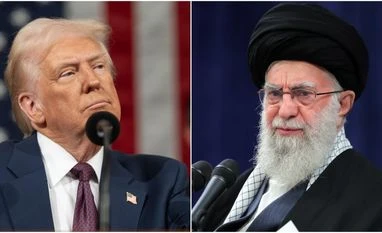 "US President Donald Trump and Iran's Supreme Leader Ayatollah Ali Khamenei")
US President Donald Trump and Iran's Supreme Leader Ayatollah Ali Khamenei. (Photos: X/@POTUS/@khamenei_ir)
Listen to This Article
US President Donald Trump has reignited discussions about negotiating a new nuclear deal with Iran. Trump, who unilaterally withdrew the US from the Iran nuclear deal in 2018, sent a letter to Iranian leadership proposing talks. However, Iran's Supreme Leader Ayatollah Ali Khamenei has rejected his overture, calling it a tactic to impose additional demands.
Here's a deep dive into the defunct Iran nuclear deal and why Trump wants to renegotiate now.
Why Trump withdrew from the Iran nuclear deal in 2018
In 2015, the US and other world powers - China, France, Germany, Russia, the UK, the US, and the EU - signed the Joint Comprehensive Plan of Action (JCPOA) with Iran to limit Tehran's nuclear programme in exchange for sanctions relief. Under the deal, Iran agreed to limit its uranium enrichment to 3.67 per cent purity, a level suitable for civilian nuclear power generation but far below the 90 per cent enrichment needed for weapons-grade uranium.
However, in 2018, Trump pulled the US out of the JCPOA, commonly known as the Iran nuclear deal. Trump criticised the deal as "defective at its core," arguing that its sunset clauses would eventually allow Iran to resume its nuclear program unchecked. He also contended that it failed to address Iran’s ballistic missile development and regional activities, which he viewed as destabilising.
Trump further accused Tehran of using financial relief from the deal to fund terrorist groups and military operations in the Middle East. Consequently, the US reimposed strict economic sanctions, launching a "maximum pressure" campaign aimed at crippling Iran’s economy and forcing it into a new agreement.
Also Read

 "Tumkur's textiles sector is facing multiple challenges like labour shortage, falling exports and bureaucratic delays")
 "BAPS Hindu temple in California")
 "savings account")
 "Donald Trump, Trump")
 "Mosquito, Dengue")
Why Trump wants to renegotiate now
In an interview with Fox Business Network broadcast on Friday, Trump said he wanted to negotiate a nuclear deal with Iran. "I said I hope you're going to negotiate, because it's going to be a lot better for Iran," Trump said.
The US President said there are "two ways Iran can be handled" - militarily or by making a deal. "I would prefer to make a deal, because I'm not looking to hurt Iran. They're great people," he said.
Trump’s renewed push for diplomacy could be due to a perception that Iran is in a weakened position and more likely to accept negotiations. Groups such as Hamas and Hezbollah, Iran's proxies engaged in war with American ally Israel in the region, have suffered significant setbacks due to Israel's military actions.
Last year, Israel conducted strikes on Iranian facilities, including missile factories and air defenses, in retaliation for Iranian missile and drone attacks. Moreover, the pager attacks on Hezbollah militia also reduced the ground operations of the group in Lebanon.
Iran's biggest backer in the region, Syria, has been diminished after the fall of Bashar al-Assad's regime, which was favourable to Tehran. Despite these setbacks, Iran has denied any loss of influence in the region.
Trump's negotiation offer also comes on the heels of a report by International Atomic Energy Agency (IAEA), which reported that Iran's enriched uranium stockpile has reached more than 27 times the allowable limit, with quantities enriched up to 60 per cent, approaching "weapons-grade levels."
Iranian officials have publicly asserted their technical capability to produce nuclear weapons, intensifying international apprehension about their intentions. Such declarations, coupled with advancements in enrichment technology, suggest that Iran could rapidly transition to weaponisation if it chooses to do so.
How Iran reacted to Trump's
Iran’s Supreme Leader Ayatollah Ali Khamenei has rejected Trump's negotiation offer. During a meeting with senior Iranian officials, Khamenei dismissed the proposal as an attempt to extract further concessions from Tehran.
“Some bully governments insist on negotiations," he stated. "But their negotiations are not aimed at solving issues, but to dominate and impose their own expectations,” reported Al Jazeera.
Khamenei emphasised that US demands go beyond nuclear restrictions, pointing to efforts to curb Iran's missile capabilities and its regional influence. “They demand restrictions on the country’s defensive capabilities and international influence, saying: ‘don’t do this, don’t meet that person, don’t produce that item’ or ‘your missile range should not exceed a certain limit,'" he added.
Iran’s state-affiliated media, Nour News, also dismissed Trump's letter as a "repetitive show," reflecting a broader skepticism within Tehran about Washington’s intentions.
(With inputs from agencies)
More From This Section
 "artificial intelligence sleep solutions, AI mattress, AI bed")
 "French President Emmanuel Macron, France, Macron")
 "Russia Ukraine conflict, Russia Ukraine")
 "commute, train, travellers")
 "The devastation of the Palisades Fire is seen at sunset in the Pacific Palisades neighborhood of Los Angeles")
Don't miss the most important news and views of the day. Get them on our Telegram channel
First Published: Mar 09 2025 | 6:30 PM IST