


Hubble telescope locates gargantuan galaxy with nine mysterious rings
Hubble Telescope previously discovered eight rings of the gargantuan structure, but astronomers confirmed the ninth ring with the help of Hawaii's WM Keck Observatory
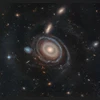 "Hubble Space Telescope has spotted a huge galaxy called LEDA 1313424")
Hubble Space Telescope has spotted a huge galaxy called LEDA 1313424 (Image: Nasa)
Listen to This Article
NASA's Hubble Space Telescope has spotted a gargantuan galaxy called LEDA 1313424, rippling with nine star-filled rings. These rings were created when a smaller blue galaxy, like an "arrow," passed through the centre of LEDA 1313424.
Astronomers who were using Hubble found eight visible rings, which is more than any other telescope has seen in any galaxy in the past. They also confirmed a ninth ring using data from the W. M. Keck Observatory in Hawaii. Previous observations show a maximum of two to three rings.
Imad Pasha, the lead researcher and a doctoral student at Yale University in New Haven, Connecticut, called it “a serendipitous discovery.”
“I was looking at a ground-based imaging survey and when I saw a galaxy with several clear rings, I was immediately drawn to it. I had to stop to investigate it,” Pasha added.
The team later nicknamed the galaxy the “Bullseye.”
Also Read

 "Class, Classroom, Education, School")
 "NASA")
 "USA China, USA China flag ,usa flag,china flag")
 "C Anandharamakrishnan")
 "Q2 earnings, Q2")
The team followed up the observations with the help of two land and space-based telescopes confirming which galaxy plunged through the centre of the Bullseye, which is a blue dwarf galaxy to its centre-left.
According to astronomers, the dwarf galaxy travelled like a dart about 50 million years ago through the core of the Bullseye, leaving rings in its wake like ripples in a pond.
Pieter G. van Dokkum, a co-author of the new study said, “We’re catching the Bullseye at a very special moment in time. There’s a very narrow window after the impact when a galaxy like this would have so many rings.”
On cosmic timescales, the galaxies collide or barely miss one another, it is extremely rare for one galaxy to dive through the centre of another. The Andromeda Galaxy, which is closest to Earth, is on its way to collide with the Milky Way galaxy.
The gargantuan Bullseye is almost two-and-a-half times larger than the Milky Way which is 1,00,000 light years in diameter.
The additional ring formation might have been staggered as the blue dwarf galaxy's flythrough affected the first rings more significantly.
More From This Section
 "Deepseek, China's AI")
 "Donald Trump, Trump")
 "Shein, Temu")
 "Palestine,Israel,Hamas,Gaza")
 "Gold")
Don't miss the most important news and views of the day. Get them on our Telegram channel
First Published: Feb 05 2025 | 6:16 PM IST