


'Grave war crimes': Iran slams Israeli attacks at UN Human Rights Council
Iran's foreign minister's statement comes as the conflict between the two countries entered its second week, with hostilities continuing to escalate
 "Seyed Abbas Araghchi,")
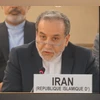
Iran’s Foreign Minister Abbas Araghchi accused Israel of committing “grave war crimes” by targeting the country’s nuclear facilities, telling the United Nations Human Rights Council that such attacks are “absolutely banned under international law”.


Listen to This Article
Iran’s Foreign Minister Abbas Araghchi on June 21 accused Israel of committing “grave war crimes” by targeting the country’s nuclear facilities, telling the United Nations Human Rights Council (UNHRC) that such attacks are “absolutely banned under international law”.
Speaking at the Council’s session in Geneva, Araghchi described Israel’s recent strikes on Iran as “unprovoked aggression” and “an unjust war” that began in the early hours of June 13. He said the operations had targeted off-duty military personnel, university professors, residential areas and hospitals, resulting in the deaths and injuries of hundreds of Iranians.
“Our peaceful nuclear facilities have also been targeted despite their being under full monitoring of the IAEA,” he said. “Israel attacks on nuclear facilities are grave war crimes, given also the danger of environmental and health catastrophe as the result of radiological leakage.”
Araghchi’s statement comes as the conflict between Iran and Israel entered its eighth day, with neither side showing any signs of de-escalating the situation.
Also Read

 "chabahar port")
 "Boarding of the evacuation flight from Ashgabat, Turkmenistan")
 "Donald Trump, Trump")
 "The US, Russia, China, France, the UK, India, Pakistan and North Korea acknowledge possessing nuclear weapons. Israel is believed to have a secret arsenal. Iran may also be on the verge of developing nukes")
 "US President Donald Trump, Chinese Premier Xi Jinping")
'Israel is committing crimes against humanity': Araghchi at UN
Araghchi urged Council members to uphold international humanitarian law and take a clear stance against what he described as a “merciless act of aggression”. He said the attacks violated Article 2(4) of the UN Charter and presented “an extremely serious danger” to the Geneva Conventions.
“The peace and rule of law are at serious stake as the result of Israel’s unlawful invasion of Iran,” he said. “Israel is committing war crimes and crimes against humanity.”
He also criticised what he called a betrayal of diplomacy, noting that Iran had been engaged in talks with the United States aimed at reaching a peaceful agreement over its nuclear programme.
“We were attacked in the midst of an ongoing diplomatic process. We were supposed to meet with Americans on June 15 to craft a very promising agreement for peaceful resolution of the issues fabricated over our peaceful nuclear programme. It was a betrayal of diplomacy and an unprecedented blow to the foundation of international law and UN system,” he said.
Calling on member states to act, Araghchi said, “This is a historic moment for human civilisation… The world, every State, every UN mechanism and body, has to be alarmed and has to act now to stop the aggressor, to end impunity, and to hold the criminals accountable.”
Israel condemns Iran being given floor at UNHRC
Earlier in the day, Israel’s Ambassador to the UN Danny Danon condemned the Council’s decision to give Iran a platform to air its views.
“The fact that Minister Araghchi has been invited to address the UN Human Rights Council in Geneva tomorrow is even more shameful and demonstrates that this UN body has lost its sense of purpose and its moral compass,” Danon said, in a letter addressed to the president of the UN Security Council.
“It is shameful,” Danon wrote, referring to Araghchi’s claim that Iran only targets military sites. “Iranian Foreign Minister Abbas Araghchi lying and claiming to target military sites is a pathetic attempt to distract from what has clearly become a modus operandi for his regime: targeting civilians and wreaking havoc and destruction on the Israeli people.”
Hostilities escalate
The situation in West Asia worsened on June 21 as both Israel and Iran stepped up their attacks. Israel struck key nuclear infrastructure sites in Iran. In a significant retaliation, Iran launched missiles equipped with cluster munitions—marking the first confirmed use of such weapons in the current conflict. One of Iran’s missiles struck an Israeli hospital on June 20, leaving many injured.
In the wake of the hospital strike, Israeli Prime Minister Benjamin Netanyahu warned that Iran’s leadership would bear a “full price” for its actions. He said Israel’s military operations were progressing faster than anticipated.
“We are moving faster than planned. Our goal is clear: to neutralise Iran’s nuclear capabilities before it is too late,” Netanyahu said.
Also on June 20, Israel’s Defence Minister Israel Katz said that Iran’s Supreme Leader Ayatollah Ali Khamenei “can no longer be allowed to exist”, pointing to what he said was the latter’s stated intent to destroy Israel.
US President Donald Trump, however, has been non-committal regarding America’s role in the conflict. While US officials are reported to be preparing for a possible strike on Iran in the coming days, President Trump on June 19, when asked if he was moving closer to striking Iran’s nuclear facilities, said: “I may do it. I may not do it. I mean, nobody knows what I’m going to do.”
While Israel has already hit Iran’s nuclear facilities at Natanz, a much more fortified complex exists under a mountain in Fodrow. As of now, only the US is said to have a bomb large enough—the 30,000-pound, bunker-busting GBU-57—that can possibly penetrate the mountainside and the fortified structure at Fodrow.
More From This Section
 "China companies")
 "State Councilor and Minister of Public Security Wang Xiaohong met with US Ambassador to China David Perdue in Beijing")
 "Soroka Hospital in Israel")
 "Bangladesh, Bangladesh Flag")
 "Iran, Iran flag")
Don't miss the most important news and views of the day. Get them on our Telegram channel
First Published: Jun 20 2025 | 10:09 PM IST