


Flash floods kill 80 in Texas as questions mount over ignored warnings
With 28 children dead, scrutiny has intensified over delayed evacuations in Texas floods and whether early warnings were adequate, especially at vulnerable sites like children's camps
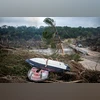 "Boats sit after being washed ashore following deadly flooding in Kerr County, Texas, U.S., July 5, 2025")
Boats sit after being washed ashore following deadly flooding in Kerr County, Texas. (Photo/ Reuters)
Listen to This Article
At least 80 people have been killed following catastrophic flash floods in central Texas, with rescue operations still underway. As the death toll is expected to rise, scrutiny has intensified over whether early warnings were sufficient and why evacuations — especially at vulnerable sites like children’s camps — were not initiated in time, according to a report by BBC.
The worst-hit area was Kerr County, where 28 children were among the deceased. A girls’ summer camp became the scene of heartbreak as floodwaters inundated the site overnight. Kerr County Judge Rob Kelly told CBS News that the magnitude of the flood came without warning.
“We had no reason to believe that this was gonna be anything like what’s happened here. None whatsoever,” Kelly said.
Timeline of flood warnings
The flooding began late Thursday and carried into early Friday. Within 45 minutes, the Guadalupe River swelled by 26 ft, breaching its banks and sweeping through towns and campsites.
According to official records, the Texas Division of Emergency Management (TDEM) activated an emergency response due to expected flooding in West and Central Texas on Wednesday. Then on Thursday afternoon, the National Weather Service (NWS) issued a flood watch for Kerr County. On Friday at 1:14 am, a flash flood warning was issued for Kerr County. At 4.03 am and 5.34 am the same day, emergency flood warnings were issued as river levels surged, BBC reported.
Also Read

 "Boats sit after being washed ashore following deadly flooding in Kerr County, Texas, U.S., July 5, 2025")
 "Floods")
 "Australia Flood, Flood")
 "US personnel, US military")
Despite these alerts, evacuations did not follow, and some residents were caught completely off guard.
Texas floods: Communication and infra gaps
Governor Greg Abbott said Texans are accustomed to flash flood warnings but emphasised the exceptional nature of this event. “But there’s no expectation of a water wall of almost 30ft high,” he said.
Texas Emergency Management Chief Nim Kidd cited technical challenges. “You have areas where there is no cell phone coverage... it doesn’t matter how many alert systems you sign up for, you’re not going to get that,” Kidd said, as quoted by BBC.
Kerrville City Manager Dalton Rice said he underestimated the danger while jogging near the river early Friday. “By 5.20 am, the water had risen so fast we almost weren’t able to get out of the park,” he said.
Judge Kelly added that Kerr County lacks a local flood alert system due to high infrastructure costs. A river warning system had been considered six years ago but was never implemented.
NWS defends its warnings amid criticism
The National Weather Service (NWS) said it issued timely alerts and held briefings on July 3. “Flash flood warnings were issued... giving preliminary lead times of more than three hours before warning criteria were met,” it said.
Some critics argued the rainfall was underestimated. However, former NWS officials defended the agency, noting the storm intensified abruptly and unpredictably, BBC reported.
ALSO READ: As the world warms up, extreme rain is becoming even more extreme
Texas floods: Staffing and budget cuts under scrutiny
The floods reignited concerns over staffing shortages and budget cuts at the National Weather Service and National Oceanic and Atmospheric Administration (NOAA). Reports mention fewer weather balloon launches and unfilled forecasting positions.
Tom Fahy, legislative director of the NWS Employees Organisation, said, “The WFOs had adequate staffing and resources as they issued timely forecasts and warnings.”
Asked about systemic failures, Homeland Security Secretary Kristi Noem emphasised the challenge of weather prediction. She said President Donald Trump is committed to modernising the country’s alert systems. “We know that everybody wants more warning time, and that’s why we’re working to upgrade the technologies,” she said, as quoted by BBC.
More From This Section
 "Leaders attending the 17th annual BRICS summit pose for a group photo in Rio de Janeiro, Sunday, July 6, 2025")
 "Red Sea, US airstrike, airstrike, Houthis, Yemen")
 "Vladimir Putin, Putin")
 "Asian market, Asian stocks")
 "Donald Trump, Trump")
Don't miss the most important news and views of the day. Get them on our Telegram channel
First Published: Jul 07 2025 | 10:26 AM IST