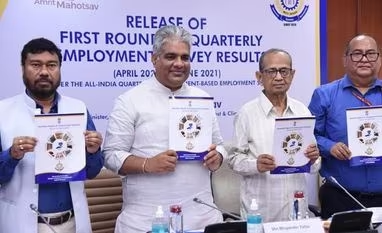
Nine organised non-farm sectors provided jobs to 29 per cent more people during the first quarter of the current financial year, the period hit by the second Covid wave, over 2013-14, showed a new official employment survey.
However, two services sectors -- trade, accommodation and restaurants -- were battered by the wave and job generation there declined by 25 per cent and 13 per cent, respectively, over this period, showed a first new revamped quarterly employment survey (QES).
On the other hand, the other services sector -- IT and BPO -- hired 152 per cent more, while it is 77 per cent higher in the case of health. This was followed by transport (68 per cent), financial services (48 per cent), and education (39 per cent), showed the survey unveiled by Labour Minister Bhupender Yadav.
Among industries, employment generated by the construction sector rose by 42 per cent and the manufacturing sector by 22 per cent. These sectors account for a majority of jobs in the non-farm establishments, said the ministry in a statement.
The findings of the survey could be compared to the sixth economic census, conducted in 2013-14, though not on a one-to-one basis. One was the normal year and the latest one was the Covid-affected quarter. Assuming that the growth rate accelerated equally, it would come to be a little over 4 per cent a year.
Pronab Sen, former chief statistician and now the head of the India programme of the International Growth Centre (IGC), was surprised over the findings on jobs in manufacturing.
“Manufacturing was affected by both developments (demonetisation and Covid-induced lockdowns). The (QES findings) are bit of a surprise. How is it possible?” said Sen.
However, a huge jump in job generation by IT/BPO and decline in employment in trade and restaurants were expected, he said.
The minister said as the survey was done after April 2021, when the second wave of Covid-19 was at its peak, trading and hospitality saw a decline (in employment generation). However, financial services have grown 48 per cent and seven out nine sectors have registered growth, he added.
“If we look at the period after 2013-14, the sectors with high employment showed an increase in employment,” he said.
“The government is committed to two things -- evidence-based policy and statistics-based execution … these two things will help in developing policy-making based on every survey and data. Data integrity and purity are of utmost importance so much so that they can even be cross-examined,” Yadav said.
He said the digital medium had been used extensively for data collection.
The labour bureau will come up with more surveys to assess different aspects of the economy from the point of view of workers, including migrant workers and domestic help.
S P Mukherjee, chairman, expert group, All India Surveys, said: “It’s not just any haphazard sampling design. I know quite a few reports coming there from different unofficial organisations where I can claim the sampling design fails to focus on the domains that are sectors of Indian economy and fails to represent different size classes.”
The new QES was launched after the earlier QES was suspended three years ago in 2018. The new QES has one more added sector in it -- financial services -- compared to the previous one. However, the two surveys cannot be compared because the earlier one covered 10,500 units while the new one covered 12,000 units and methodology of the previous one is not available, an official said.
Officials said work on surveys on the unorganised sector was progressing and later surveys would cover both the formal and informal sectors. The survey covers establishments with at least 10 workers.
The National Statistical Office, under the Ministry of Statistics and Programme Implementation, does periodic labour force surveys (PLFS). That is a household survey or from the supply side of the economy. The QES is an establishment-based survey or gauging the job scenario from the demand side of the economy.

 "Organised sector weathers second Covid wave on job front: Labour survey")











