Home / India News / 'Moderate' fog in Delhi, minimum temperature rises to 14.4 degrees Celsius
'Moderate' fog in Delhi, minimum temperature rises to 14.4 degrees Celsius
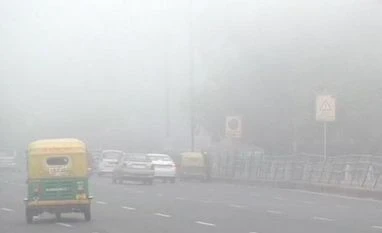
"Moderate" fog in parts of Delhi lowered visibility to 300 meters on Thursday, even as the minimum temperature in the city rose to 14.4 degrees Celsius, the highest in around four weeks
"Moderate" fog in parts of Delhi lowered visibility to 300 meters on Thursday, even as the minimum temperature in the city rose to 14.4 degrees Celsius, the highest in around four weeks.
Visibility levels dipped to 300 meters at Palam and 500 meters at Safdarjung due to "moderate" fog, an official of the India Meteorological Department (IMD) said.
According to the IMD, "very dense" fog is when visibility is between 0 and 50 metres. In case of "dense" fog, visibility is between 51 and 200 metres, "moderate" 201 and 500 metres, and "shallow" 501 and 1,000 metres.
The Safdarjung Observatory, which provides representative data for the city, recorded a minimum of 14.4 degrees Celsius. The minimum temperature in the city has risen over the last few days as a result of cloud cover.
Clouds trap some of the outgoing infrared radiation and radiate it back downward, warming the ground.
Delhi witnessed rainfall on four consecutive days till Wednesday under the influence of a strong Western Disturbance affecting northwest India.
The precipitation has increased the moisture content in the air. Dense fog is predicted in the city over the next two days, an IMD official said.
A fresh WD may lead to "very light" rain in the city on January 9. The weather will remain cloudy, Kuldeep Srivastava, the head of the IMD's regional forecastingcentre, said.
Thereafter, Delhi's minimum temperature is likely to dip by four to five degrees Celsius with the commencement of northwesterly winds from snow-capped mountains towards the plains.
The IMD said Delhi has already recorded 56.6 mm rainfall in January, the maximum for the month in 21 years.
Sporadic rains drenched the city for the fourth consecutive day on Wednesday. Clouds blanketed the capital on Thursday as well. However, only a drizzle is expected, the IMD said.
On an average, Delhi records 21.7 mm in January every year.It had gauged 48.1 mm rainfall in January last year, 54.1 mm rainfall in January, 2019 and 59.7 mm in January, 1999.
The city had registered 69.8 mm rainfall in the month in 1995, according to IMD data.
(Only the headline and picture of this report may have been reworked by the Business Standard staff; the rest of the content is auto-generated from a syndicated feed.)

 "'Moderate' fog in Delhi, minimum temperature rises to 14.4 degrees Celsius")


 Connect with us on WhatsApp