Election 2019 may see the highest voter turnout, but will it benefit BJP?

Increased voter turnout seems to be concentrated in states where the voters have been at the forefront of the ongoing rural distress
lok sabha elections
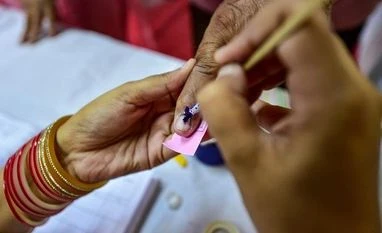
A polling officer puts indelible ink mark on the finger of a voter during the sixth phase of the 2019 Lok Sabha elections | PTI
Puneet Wadhwa New Delhi
3 min read Last Updated : May 14 2019 | 4:04 PM IST
As the election 2019 season enters the final lap with polling left only for one phase of the seven scheduled, voter turnout this time around is likely to create a record. According to reports, the 2019 election is on track to achieve record voter turnout of around 67 per cent (55 – 56 million new voters relative to 2014 general elections), which would surpass the previous record of 66.4 per cent during the 2014 polls.

ALSO READ: Lok Sabha elections 2019: The rise and rise of the rational Indian voter 

As per the data available with the Election Commission of India (ECI), voter turnout in the first four phases stood at 69.5 per cent (first phase), 69.44 per cent (second phase), 68.4 per cent (third phase) and 65.51 per cent (fourth phase).

Constituency-wise comparison, as per a Nomura report suggests that in the first four phases (around 69 per cent of the seats), increased voter participation was concentrated in the key Bharatiya Janata Party (BJP) bastions of Rajasthan, Madhya Pradesh, Jharkhand, Chhattisgarh, Gujarat, Assam and Karnataka. 

ALSO READ: UP to dent BJP tally, BSP-NDA post-poll alliance possible: Ambit Capital

“The two outliers are Andhra Pradesh and Kerala, where voter turnout was high, but the BJP’s prospects have traditionally been weak,” the report says.

So, will the BJP/National Democratic Alliance (NDA) benefit from this higher voter turnout or will it succumb to anti-incumbency?

Both theoretical and empirical studies, according to Nomura, have struggled to find causality between voter turnout and election outcomes. In past Lok Sabha elections, there have been anti-incumbency outcomes during both high and low turnout elections.

ALSO READ: 63.3% voter turnout in sixth phase, says EC

“On the one hand, increased voter turnout may indicate a strong sense of dissatisfaction that has led to voters coalescing to boot out the incumbent, although studies have disputed this causality in previous elections,” wrote Sonal Varma, managing director and chief India economist at Nomura in a recent co-authored report with Aurodeep Nandi.

Adding: “On the other hand, high voter turnout could reflect active participation at the grass root level, with the party cadre coaxing citizens to vote. It may also be indicative of more structural, party-agnostic trends, wherein increased social media outreach, general political awareness and ease of voting contribute to participation of previously dormant registered voters.”

Their analysis suggests that increased voter turnout seems to be concentrated in states where the voters have been at the forefront of the ongoing rural distress and have recently expressed anti-incumbency views against the BJP. These states form the ‘Hindi heartland’ states for the BJP. As a base-case, Nomura expects Narendra Modi – led NDA to return to power, albeit with a reduced majority.

ALSO READ: Number of Lok Sabha candidates with criminal cases up 4% in 10 years

This view has also been endorsed by other brokerages such as Ambit Capital and CLSA, who see Modi returning to power for the second time around, but with reduced numbers. The state of Uttar Pradesh (UP), according to Ambit, remains the key for the overall tally for NDA. The electoral alliance between the Bahujan Samaj Party (BSP), the Samajwadi Party (SP), and the Rashtriya Lok Dal (RLD) is certain to dent BJP’s seat count in UP, Ambit says.

One subscription. Two world-class reads.

Already subscribed? Log in

Subscribe to read the full story →
*Subscribe to Business Standard digital and get complimentary access to The New York Times

Smart Quarterly

₹900

3 Months

₹300/Month

SAVE 25%

Smart Essential

₹2,700

1 Year

₹225/Month

SAVE 46%
*Complimentary New York Times access for the 2nd year will be given after 12 months

Super Saver

₹3,900

2 Years

₹162/Month

Subscribe

Renews automatically, cancel anytime

Here’s what’s included in our digital subscription plans

Exclusive premium stories online

  • Over 30 premium stories daily, handpicked by our editors

Complimentary Access to The New York Times

  • News, Games, Cooking, Audio, Wirecutter & The Athletic

Business Standard Epaper

  • Digital replica of our daily newspaper — with options to read, save, and share

Curated Newsletters

  • Insights on markets, finance, politics, tech, and more delivered to your inbox

Market Analysis & Investment Insights

  • In-depth market analysis & insights with access to The Smart Investor

Archives

  • Repository of articles and publications dating back to 1997

Ad-free Reading

  • Uninterrupted reading experience with no advertisements

Seamless Access Across All Devices

  • Access Business Standard across devices — mobile, tablet, or PC, via web or app

Next Story



