
Myanmar coup: Internet restored after being shut for second night
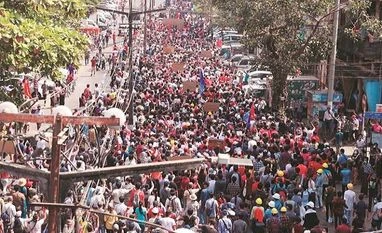
Earlier, the military authorities announced stiff penalties for those opposing the coup leaders. Protesters, however, were out again early on Tuesday, the BBC reported
 "Myanmar coup: Internet restored after being shut for second night")
WebinarsNew
Deep DiveNew
Explore Business Standard
Earlier, the military authorities announced stiff penalties for those opposing the coup leaders. Protesters, however, were out again early on Tuesday, the BBC reported
Internet access has been restored by Myanmar's new military rulers after it was blocked for the second night in a row.
The blackout -- the fourth shutdown since the February 1 coup came as the junta tries to stifle dissent by the demonstrators demanding the release from detention of their elected leaders, including Aung San Suu Kyi, and the restoration of democracy.
Earlier, the military authorities announced stiff penalties for those opposing the coup leaders. Protesters, however, were out again early on Tuesday, the BBC reported.
They have been encouraging civil servants to join the civil disobedience movement in the main city of Yangon.
The United Nations Special Envoy Christine Schraner Burgener reminded the head of the military junta in a phone call that "the right of peaceful assembly must fully be respected", according to a UN spokesman, warning him that "any form of heavy handed response is likely to have severe consequences".
The junta says it overthrew elected leaders, including longtime democracy campaigner, Aung San Suu Kyi, due to alleged voter fraud. It has not provided any evidence to support these claims.
The latest shutdown follows a pattern aimed at disrupting continuing opposition to the coup and the detention of leaders, including Suu Kyi, whose party won a resounding victory last November.
Access to Facebook, a rallying point for a campaign of civil disobedience, was restricted soon after the coup. Use of Twitter and Instagram was also disrupted. But activists also fear the blackout may be used to arrest more people.
Major telecoms provider Telenor has said it will no longer be updating a list on its website of internet disruption.
The military's presence is growing. At many strategic locations, soldiers have replaced the police.
In the main city, Yangon, eight-wheeled armoured vehicles have been seen trying to navigate the rush-hour traffic, sometimes surrounded by cars honking in opposition to the coup.
On Monday, protests focused on the central bank building, the US and Chinese embassies, and the city headquarters of Su Kyi's National League for Democracy.
And as demonstrators gathered in the central city of Mandalay, there were reports of security forces firing rubber bullets to disperse crowds.
In footage posted on social media, the sound of what appears to be gunshots can be heard as crowds flee, with several people later appearing to display injuries.
A leading student activist who has gone into hiding, Myo Ko Ko, told the BBC why he and others were willing to risk their lives.
"We strongly believe in democracy and human rights. We know that it's risky," he said.
"I have to move to another place day by day because of being searched (for) by police. We hope the international community will help us."
Students also protested in the capital, Nay Pyi Taw. Dozens were arrested and later released.
Residents in several cities are reported to have formed night-watch groups to deter mobs rumoured to have been dispatched by the military to cause unrest.
--IANS
int/pgh
(Only the headline and picture of this report may have been reworked by the Business Standard staff; the rest of the content is auto-generated from a syndicated feed.)
First Published: Feb 16 2021 | 11:54 AM IST


 Connect with us on WhatsApp