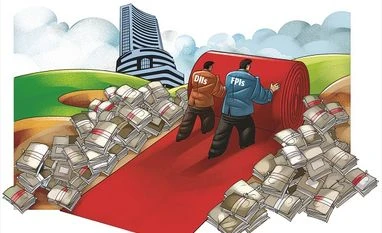
Western “fashions” drive the Indian stock market for good reason. In this context, fashion of course, refers to investment models and theories rather than the length of skirts or the colour of socks. Indian investors tend to obsessively track and imitate the foreign portfolio investors (FPIs).
When the FPIs are chasing growth, Indian investors also focus on growth; when FPIs seek value, India looks at value. When FPIs approve of focussed single-business entities, Indian investors also fancy single-business entities. When FPIs are enticed by the chances of unlocking hidden assets on a conglomerate's balance-sheet, Indian investors are tempted by the same. This is simply because FPIs own a big chunk of the Indian market and they are very active players and so, many Indian investors follow their lead.
Every investment theory works well part of the time and it is less successful at other times. Both, growth investing methods and value investing methods can be highly successful. There are times when single-business firms do well and there are times when conglomerates do better. It depends on the prevailing phases of the business cycle. Growth stocks can trend up to unrealistic levels until the growth tapers off at some stage.
Value investors suffer in comparison during periods when growth stocks receive very high valuations. But, value investors gain in bear markets or during periods of disruption. That's when they can pick up stocks cheap.
Single business stocks always experience some cyclicality. There will be periods of high growth, and periods of slow growth or recession. Conglomerates hold the advantage in those terms. A conglomerate can tend to have one business or another that's always chugging along profitably. On the other hand, conglomerates will usually hold one or more businesses, which are performing poorly because of cyclical reasons. That can drag them down in comparison to single-businesses when the single business is at its peak. Plus it is harder to make a clear judgment about conglomerate financials, which usually means less optimistic valuations.
Right now, the FPIs seem to be buying a wide selection of stocks, - anything that fulfils basic size requirements because it doesn't make sense for them to invest in very small stocks. The FPIs have logged Rs 28,068 crore worth of net equity buying so far in the January-March 2017 quarter. They have also bought Rs 10,183 crore of net rupee debt.
This buying coupled to domestic enthusiasm has put the market into a phase where overvaluation is visible across most sectors. The major market index, the Nifty, is trading at a price-to-earnings (PE) of about 23.8. That is well above its 12-year median, PE 20.1 and its average, PE 19.7. (The median being higher than the mean indicates many low PE values in this case).
The Nifty trades above PE 24 very rarely. Since 2005, it has traded to above PE 24 only about 4.5 per cent of the time. However, peak Nifty valuations have edged all the way to PE 28 so there is still arguably an upside even at current levels. Optimists will point to the fact that EPS growth has picked up in the past three quarters. If EPS growth is maintained, prices could rise further while valuations stay stable.
Although there could be an upside, valuations always revert to mean/median range eventually. This is a real danger in an overheated market. Investor should seek a margin of safety by finding stocks that are relatively less highly valued. Switching to value investing approach is a good defence against a crash. However, many investors will continue to play follow-the-leader and invest wherever the FPIs are going. That model will yield painful losses, as and when the FPIs decide to book profits.
The author is a technical and equity analyst

 "High time investors look at value investing")












 Connect with us on WhatsApp