The novel coronavirus has globalised. And it is playing havoc. It has killed or sickened people in 73 countries. It has sent stock markets shivering. It has paralysed economic activity in China and parts of East Asia, the manufacturing engine of the world. It could potentially send the global economy into a severe downturn or recession. At this stage, around two months after the first outbreak in Wuhan, no one can confidently predict where this will end. However, what is clear is that fundamentals matter — for individuals, health systems and for the economy — even in the most unpredictable circumstances. It’s a useful reminder for India as the virus threatens to make its presence felt.
It may take some time before epidemiologists and clinicians fully understand Covid-19. Initial evidence suggests that an individual’s fundamental health parameters may be critical in determining the final impact of the disease. Those who are healthy have a much higher probability of experiencing mild illness and full recovery without hospitalisation. Those who have underlying health conditions are more likely to be severely ill. In India, the vulnerability is two-fold. At one end of the spectrum, there are the many who are malnourished and under-nourished in the low-income groups. At the other end, in the middle- and high-income groups, there’s the growing burden of lifestyle disease, such as diabetes, hypertension and coronary diseases.
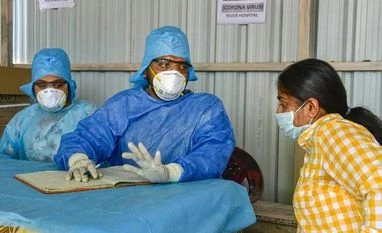
An Indian woman who recently returned from the United States being examined by doctors at a novel coronavirus help desk, at a hospital in Hyderabad
India’s health system is ill-equipped to even deal with the existing burden of disease. A highly contagious viral epidemic would expose it completely, especially the system of primary care. India is woefully short of doctors. It is also terribly short of hospital beds. The number of doctors per 1,000 people in India was 0.62 in 2017, significantly less than the WHO-mandated minimum norm of at least one per 1,000. India has 2.7 hospital beds per 1,000 persons, which is, again, much less than the WHO-mandated norm of at least five per 1,000. China has 1.5 doctors per 1,000 people and around five hospital beds per thousand, but has struggled to manage the outbreak. India does not have the state capacity to build two massive hospitals in a fortnight and to convert any large space like a stadium into a hospital at short notice which is the strategy China adopted to deal with the sheer number of patients. It is important to note that other diseases won’t go away while hospitals and doctors deal with Covid-19. This would be an additional burden on an already stretched system. While governments over the years must take a share of the blame for under investing in the public health system, the medical fraternity (through the Medical Council of India) also bears responsibility for the failure to train more doctors because of restrictive regulations.
The consequences of an outbreak of Covid-19 in India will spread beyond those who get sick. If restrictions need to be imposed on the movement of people, on the functioning of offices, the working of factories/call centres, there will be a quantum impact on growth. That would be a body blow to an economy that is growing at a sub-5 per cent level. There is hardly any room for a stimulus. The government’s fiscal deficit is already beyond its target. The states have no spare financial resources. On the monetary side, there is probably greater room, but given the perilous state of the banking system and the lack of monetary transmission, rate cuts by the RBI may not have an impact. India’s short-term policy options are very limited compared to China or the US. The economy may yet rue the lack of deep structural reforms which would have made the fundamentals much stronger and enabled a quick comeback from any black swan event-induced downturn.
But it isn’t all gloom. There are at least two bright spots in India’s fundamentals story which could prevent Covid-19 from reaching epidemic proportions. First, India is an open, democratic society with free flow of information and elected governments at the Centre and states that are responsive to public pressure. The two countries which have borne the worst of the pandemic are China and Iran where there is sufficient evidence to suggest that prompt action was delayed because authorities suppressed or denied the existence of a threatening pathogen until it had already spread wide. Second, India has a formidable bureaucratic machinery which is trained to “control” and can be effective when in Mission Mode. The administrative response to the recent viral outbreak of Nipah or even the quick evacuation of Indian nationals from Wuhan shows the government can be responsive and effective when it wants to.
India has the capacity to prevent an epidemic of vast proportions. It may have less capacity to battle a full-blown one. The next fortnight is crucial.
The author is chief economist, Vedanta

 "In Covid-19 fight, it's about fundamentals")












 Connect with us on WhatsApp