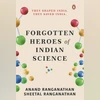
Forgotten Heroes of Indian Science: Discoveries that shaped global health

They lived under British rule, struggled to overcome racial barriers, and contended with inadequate resources, yet left the world healthier through their groundbreaking discoveries

book review
Forgotten heroes of Indian science
Devangshu Datta Mumbai
5 min read Last Updated : Jan 15 2026 | 10:33 PM IST
Forgotten heroes of Indian science
By Anand Ranganathan & Sheetal Ranganathan
Published by Penguin
538 pages  ₹999 
This book focuses on the achievements of five individuals (two of whom worked in tandem), roughly between 1875 and 1950. All of them were Indians, and they had significant scientific and technical feats to their credit, in different fields of bioscience. All of them were trained and educated in institutions established by the British rulers of the subcontinent, and they lived out their working lives during the era of British rule (though one of them did most of his work in the US). 
All of them struggled to overcome barriers of race and contended with inadequate resources. Each of them succeeded to the extent that they managed to put together a very significant body of work. However, none of them got the recognition they deserved. Part of the problem may also be the generally ahistorical culture of India where things are badly documented, and archival records and data are pigeon-holed and forgotten. 
The authors are both trained in the biosciences so it is not surprising that they chose to focus on individuals who were working in those fields. The essays are buttressed by solid research and supported by meticulous footnotes. 
However, the focus in the writing is less on the science and more on the socio-political environments in which these men worked, which was, of course, under British rule. And in all but one case, they worked as employees of British-run institutions. There is a strong nationalistic tinge to the presentation of these lives, to the point where it sometimes obscures the magnitude of their achievements. Also, the book employs the conventions of “faction”, dramatising the narrative and embellishing it with plausible dialogue and the description of likely emotions at critical moments of their lives. 
Also, in an apparent attempt to explain the context, each essay starts with a long exposition on the historical background. This can get tedious and some of it seems irrelevant. For example, the first essay on U N Brahmachari starts about 50 years before his birth in 1873 before coming to the prevalence of Kala Azar, the disease which was Brahmachari’s principal battleground. The other essays have similar “slow-burn” introductions that can test readers’ patience.
 
The other irritant is a stylistic tic — there are far too many adjectives and much over-amplification. To take an example at random: “The Ahom kingdom had been mercilessly rolled down a steep slope of destruction.”
 
The diligent reader who can get past these challenges will find much to engage with in this book and its fun going down the rabbit holes of footnotes and references. Brahmachari figured out how to combat Kala Azar, discovering a way to isolate urea stibamine from Antimony compounds. That drug was pretty much the only effective antidote to visceral leishmaniasis, to give the black fever its scientific name. It reduced mortality from 90 per cent to around 10 per cent, according to the authors.
 
The second essay is about Ram Nath Chopra, who discovered or rather rediscovered the therapeutic properties of sarpagandha. Chopra was among the few researchers who sought to discover and isolate the active ingredients of plants mentioned in the ayurveda tradition. He, along with Rustam Vakil, was among the first researchers to flag blood pressure variations as potentially life threatening. Reserpine, one of the drugs derived from sarpagandha, and later synthesised, is now a standard drug for hypertension.
 
The third essay features Azizul Haque and Hem Chandra Bose. Haque and Bose were with the Bengal police when they were tasked with an analysis of fingerprints by the Inspector General, Edward Richard Henry. They developed a practical system of classification of fingerprints that made it possible to use these in forensic investigations. This pioneering work is called the Henry system however — he hogged the credit for presenting it to Scotland Yard, and only reluctantly acknowledged the fact that Bose and Haque had actually developed the system.
 
The fourth essay is by far the longest and Yellapragada Subbarow had the least conventional career trajectory. “Subbu” as he’s referred to, ran away from home at age 12, was recaptured and returned to the custody of his overbearing mother. He qualified as a doctor, briefly flirted with becoming a monk of the Ramakrishna Mission, and was more or less blackmailed into marrying into the family of a benefactor. Then he went to Harvard and spent the rest of his life in America.
 
He discovered the function of adenosine triphosphate (ATP) as an energy source in the cell, and led the department at Lederle Laboratories in which Benjamin Minge Duggar discovered chlortetracycline. He discovered folic acid as a cure for tropical sprue. He discovered methotrexate, a chemotherapy drug and diethylcarbamazine (DEC), the only effective drug for treating filariasis. That’s an amazing body of work — many Nobels have been awarded for less.  He was only 53 when he died.
 
Despite the flaws, this well-researched book is worth the effort of wading through. These are men who deserve recognition, belated though it may be.

One subscription. Two world-class reads.

Already subscribed? Log in

Subscribe to read the full story →
*Subscribe to Business Standard digital and get complimentary access to The New York Times

Smart Quarterly

₹900

3 Months

₹300/Month

SAVE 25%

Smart Essential

₹2,700

1 Year

₹225/Month

SAVE 46%
*Complimentary New York Times access for the 2nd year will be given after 12 months

Super Saver

₹3,900

2 Years

₹162/Month

Subscribe

Renews automatically, cancel anytime

Here’s what’s included in our digital subscription plans

Exclusive premium stories online

  • Over 30 premium stories daily, handpicked by our editors

Complimentary Access to The New York Times

  • News, Games, Cooking, Audio, Wirecutter & The Athletic

Business Standard Epaper

  • Digital replica of our daily newspaper — with options to read, save, and share

Curated Newsletters

  • Insights on markets, finance, politics, tech, and more delivered to your inbox

Market Analysis & Investment Insights

  • In-depth market analysis & insights with access to The Smart Investor

Archives

  • Repository of articles and publications dating back to 1997

Ad-free Reading

  • Uninterrupted reading experience with no advertisements

Seamless Access Across All Devices

  • Access Business Standard across devices — mobile, tablet, or PC, via web or app

Topics :ScienceBritish ruleScientistsColonialismBOOK REVIEWBook readingBS Reads

Next Story