Revolting: A History of the World in 77 Rebellions
Most well-known for his Horrible Histories books written for children, Terry Deary is a writer with more than 300 titles to his name. His latest book, Revolting: A History of the World in 77 Rebellions, is aimed at a more mature audience than the Horrible Histories series but is written in the quintessential Deary style — with black humour and a sense of irony.
Through its accounts of various revolts in the course of history, Revolting takes readers on a tour around the world. The book is divided into 10 chapters, with each chapter further divided into two sections: Reason to Revolt, and Lesson from History. The reasons for revolts include — but are not limited to — money, revenge, slavery, hunger, religion and injustice. The lessons from history, on the other hand, are as varied as choosing the right leader, gathering intelligence, fighting for the cause, and even hoisting one’s flag. Not surprisingly, Mr Deary manages to find multiple rebellions that can be grouped under a single heading and every chapter gives a short historical account of more than one rebellion. The chapters still manage to stay on the shorter side, making it possible for busy readers to finish reading a section and then pick the book again at a later date without feeling lost in the narrative. On the other hand, this also means that reading the entire book in a single go makes it difficult to retain the details of most of these historical events.
One of the strengths of Revolting lies in Mr Deary’s choice of including lesser-known rebellions and episodes from history. Ancient history finds ample space in the book and we learn of rebellions as old as the Red Eyebrow Rebellion of the Chinese Peasants in 17 AD, the St Scholastica Day Riot of Oxford in 1355, The Taborite Rebels in Bohemia in 1420 and the assassination of Caracalla in imperial Rome in AD 217, to name a few. This isn’t to say that Mr Deary ignores the more contemporary or the more well-known revolts altogether, but his focus is on bringing the unknown and lesser-known acts of rebellion to light. He also sets facts straight, drawing readers’ attention to the atrocities committed and truths misrepresented by the victors for a long period in history. By going into details of the punishments devised by the “civilised” nations for the rebellious people of their colonies, Mr Deary brings home the truth of these practices.
Unsung heroes of the past, such as Olympe de Gouges, who worked relentlessly for women’s rights during the French Revolution, also find a place of prominence here. In the same vein, Revolting also corrects the facts about historical figures who have been unequivocally declared heroes by posterity, their chequered history forgotten or deliberately ignored to suit the narrative. Mr Deary also sets the record straight in other ways. For instance, he points out that there is no proof that Ned Ludd, after whom the Luddite movement was named, ever existed. He further manages to capture readers’ interest through the use of historical trivia and “conspiracy theories” for his readers, such as the theory that Queen Elizabeth I died when she was a child and was replaced by a boy.
Though entertaining, Revolting isn’t without its flaws. Its short chapters filled with interesting trivia and historical details make for easy reading, but it’s equally easy to forget them or get them mixed up as it focuses on giving readers a broader perspective rather than covering historical events in depth. Although it features rebellions from around the world, events from European history dominate the numbers, making it a more rewarding read for those with a greater familiarity with the continent’s past.
Mr Deary’s writing style isn’t for everyone either. While Revolting is a book for older readers, the tone and humour of the book along with its focus on details of gruesome punishments — even with his light touch and levity — can alienate a serious history enthusiast. There are moments when his writing style seems more suitable for a YA (young adult) audience. In fact, given the similarities in the writing style, it is possible to look at Revolting as a Horrible History book written for older readers. Revolting is not a book meant for a scholarly glimpse into history. But its humorous writing, short chapters and accessible style make it suitable for someone who is intrigued by the past and wants a non-sanitised version without being bogged down by too many details.

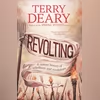 "Revolting: How Terry Deary retells history through revolt and irony")












 Connect with us on WhatsApp