The Social Life of Indian Trains
Published by Aleph Book Company
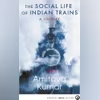
In the last chapter of his latest book, The Social Life of Indian Trains, Amitava Kumar writes: “The railway is part of the public wealth, perhaps among our most shared precious resource, and when we are travelling on trains, we are not just passengers but also fellow members of the republic.” This is a perfect summation of both the book, and the impulse to read it. Slim, at just 130 pages, the book might be a bit of a disappointment for readers looking for an in-depth account of the history and socio-economic aspects of the Indian Railways. Kumar rarely gets into the nitty-gritty of historical details, and chooses instead to zoom in on his own train journeys and those he knows as anecdotes — these he then skillfully zooms out from to present the mammoth enterprise as an everyday reality of Indian society across regions.
For the purpose of writing this book, Kumar undertook several train journeys over the course of a year, and the most interesting (and the one that takes up most space in the volume) is the three-day long Himsagar Express, which took him from Jammu to Kanyakumari. Even someone who was mildly curious about trains would have wondered what the experience of taking this train would be like: The fantastical dream of covering the length of India by train, encountering people one would normally not meet otherwise, and more.
The book’s description of the journey may provide a good litmus test for those who are semi-serious about taking this journey at least once. Inspired by a 1967 documentary, I Am 20,in which a group of 20-year-olds is asked a series of questions related to the 20th anniversary of Indian independence, and their hopes and expectations from the country, Kumar sets out to do the same. “It seemed possible, even easy, to hop on a train, talk to people, and take notes,” he writes — but the reality is far from his idealistic expectations. His first meal (which he orders online) is cancelled, his companions watch videos at full volume on their phones, and he finds that he cannot have the conversations he had hoped to.
However, his interactions (across cars and compartments) reveal some truths about how the hands that build India traverse India. Referring to the problem of overcrowding in general compartments, a ticket examiner says the “railways had been making fools of poor customers”, who are “packed in like people fleeing some devastating catastrophe”. Meanwhile, the middle- and upper-classes have assigned seats and berths in air-conditioned cars, and suffer only from “filthy toilets and close intimacy with loud passengers”.
Kumar also goes on to map how India has changed over the last decade. He meets a pleasant couple who soon begin to extol the virtues of VD Savarkar and his Hindutva ideology —he then reflects on how “the presence of a demonic other” has pervaded even Indian Railways. He talks about the 2023 incident where a railway constable had killed three Muslim passengers and a sub-inspector, and later asked other passengers to record a video of him going on a tirade against the minority.
The focus is not just on the people and situations Kumar encounters during the course of writing this book — he frames the Railways as something central to his life in India, without him even realising it. This invites readers to ruminate on their own relationships with Indian trains. The personal also becomes historical in Kumar’s telling of the railway story: He charts the journey of how trains became ubiquitous despite the caste system and its anxieties of preserving hierarchy and ‘purity’ through personal narratives preserved in academic studies. He also emphasises how the introduction of Railways by the British led to a complete upheaval of the Indian agricultural system, and how this vast network was used during the famines to deprive available grains from people who actually needed them. However, the use of miles as a unit of distance is a bit distracting, since most Indians are used to the metric system, and the Railways itself employs it.
After colonialism, Kumar elaborates on how trains became a simultaneous spectre of hope and death during Partition. Through news reports and fiction, he shows the reader that as much as Railways have had a role to play in India’s successes, it has been an equal contributor in its tragedies, too.
Despite its short length, Kumar’s book looks at a range of themes concerning the Railways, in depth. Mixing the personal and political, he makes a compelling case for looking at train travel in India as a “possibility of an exchange that strengthens our social contract” as citizens of a country bursting at the seams with diversity.

 "The Railways as social contract: What Amitava Kumar's book reveals")










 Connect with us on WhatsApp