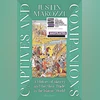
CAPTIVES AND COMPANIONS: A History of Slavery and the Slave Trade in the Islamic World
By Justin Marozzi
Published by Pegasus
524 pages $35
Thomas Meaney
When the British journalist Justin Marozzi was covering the 2011 uprising in Libya, he encountered something that profoundly confused him. Meeting in Tripoli with a group of rebels, he heard one turn to a Black comrade and say, “Hey, slave! Go and get me a coffee!”
As Marozzi writes in Captives and Companions, his knotty history of slavery in the Middle East, the other rebels were “clearly” amused, even if “it was equally clear” that their comrade was not.
The practice of slavery persists in the Middle East today in shadowy forms. In Lebanon and Qatar, for instance, the “kafala system” cycles African migrants into coercive contracts as maids or construction workers. But what most galled Marozzi in 2011 wasn’t a case of actual servitude; it was the fact that the term “slave” was still in regular use, even outside its original context. How did such casual utterances relate to the thousand-year legacy of bondage in the region?
As Marozzi explores this question, he showcases the many types of enslaved people — eunuchs, harem women, mercenaries, unpaid labourers — who populated a region that stretches across modern-day Libya, Turkey, Iraq, Iran, Yemen, Oman and Saudi Arabia, all the while demonstrating how the realities of bondage in these places differed from the more familiar chattel slavery of the West.
Until the late 19th century, slavery was a near universal institution. Marozzi refers to his scope of interest as the “Islamic world,” apparently because slavery, like so many other iniquities, was justified by the existence of rules found in religious codes.
But were Quranic precedents and injunctions decisive? As the author himself is quick to note, almost no one followed the official guidance about slavery, especially rules proscribing rights for the enslaved, which Marozzi tells us were the most “progressive” of the Abrahamic religions. “While Christians professed equality before God, Jews offered reduced penalties for adultery with slaves and Romans prohibited slave prostitution,” he observes, “only the Quran did all three.”
How significant was racism in the practice of slavery by Muslims? Marozzi suggests that the advent of racial prejudice in the Middle East might have preceded the rise of modern European racism by several centuries. He quotes, for instance, the 13th-century Persian philosopher Nasir al Din al Tusi: “The Negro does not differ from an animal in anything except in the fact that his hands have been lifted from the earth.”
Having travelled to most of the countries he writes about, Marozzi is aware of the pitfalls of his project. He appears to know how easy it is to descend into lazy generalisations about Islamic culture, and, in doing so, to prop up Western self-regard. Nevertheless, Marozzi appears reluctant to wriggle free from some of the most robust myths of the Victorian age. For instance, he argues that the Ottoman slave trade “did not die a natural death.” Instead, “under unrelenting European pressure, it withered for decades in the 19th century before eventually dying in the 20th.”
That may be how it looks to Western eyes, but the Ottomans had their own reasons for terminating the trade, however haltingly. Nineteenth-century Ottoman reformers needed little encouragement to eradicate a slave system presided over by the very elites they wanted to overthrow. Local abolitionist bureaucrats, Islamic rulings sanctioning abolition and changes in agriculture all likely contributed as much to the end of Ottoman slavery as the chiding of British officials dispatched to the empire in the 1840s and 1850s.
Marozzi prefers not to think too closely about his book’s assumption. “Our story is not about historians,” he writes. “Nor is it a history of history.” But, to borrow a phrase, journalists who declare themselves exempt from the influence of historiography are often the captives of some defunct historian.
In the case of Marozzi, that historian may be the Princeton professor Bernard Lewis. In Race and Slavery in the Middle East, a book that Marozzi happily cites, Lewis updated his thesis to dispel the notion that people in countries like Iraq and Afghanistan were innocent victims of European imperial might. Instead, he suggested, the pervasiveness of slavery in the Middle East showed they had been practitioners of evil all on their own. Unsurprisingly, Lewis became a favourite court scholar of the George W. Bush administration as it prepared to invade Iraq.
Captives and Companions is a more engrossing and less polemical read than Lewis’s books, and Marozzi deserves credit for lighting up a vast subject with vivid tales that throw Atlantic slavery sharply into relief as the more historically startling development.
Yet readers should be cautious with what they do with their discomfort. At the turn of the 20th century in the Congo, King Leopold II of Belgium launched an enslavement campaign that would leave 10 million people dead. It was not for nothing that he declared his mission was to eradicate Arab slavery.
The reviewer is editor of Granta ©2025 The New York Times News Service


 "What histories of Islamic-world slavery get right, and what they miss")

