


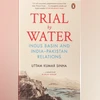
 "Trial by Water: Assessing the paradoxical legacy of Indus Waters Treaty")


Trial by Water: Indus Basin and India-Pakistan Relations
by Uttam Kumar Sinha
Published by Vintage
352 pages - ₹599
India has decided that blood and water will not flow together,” said Prime Minister Narendra Modi during his Independence Day address at Delhi’s Red Fort three weeks ago. He was defending India’s decision to place the Indus Waters Treaty, signed with Pakistan in 1960, in abeyance following the Pahalgam terrorist attack in April that led to the killing of 26 civilians.
Also Read
That water diplomacy cannot co-exist with cross-border terrorism seems like a no-brainer but, unsurprisingly, it has met with staunch opposition from Pakistan. Most recently at the Shanghai Cooperation Organisation (SCO) Summit in Tianjin, Prime Minister Shehbaz Sharif urged member countries to follow bilateral treaties, and ensure “uninterrupted access to due share of water”.
Uttam Kumar Sinha’s book Trial by Water: Indus Basin and India-Pakistan Relations would be useful to anyone who is keen to understand India’s official stance through a historical framework and the lens of national security. The author, a senior fellow at the Manohar Parrikar Institute for Defence Studies and Analyses, is an authoritative voice on transboundary water governance.
Mr Sinha is committed to championing India’s official narrative, and does not pretend to offer a dispassionate academic view that also takes Pakistani perspectives into consideration. According to him, India has “largely adhered to a stance of legal rectitude, punctuated occasionally by strategic signalling,” whereas Pakistan has portrayed the treaty as “an unequal arrangement” to look like a victim in the international arena and to delegitimise “Indian infrastructure projects”. It is not hard to imagine a Pakistani expert arguing from a similarly nationalistic standpoint.
The author has some thought-provoking insights on the divergent styles of leadership embodied by Prime Minister Jawaharlal Nehru—an idealist hopeful of regional cooperation, who signed the treaty “as a gesture of principled magnanimity”— and the current Prime Minister who prefers a “harder, interest-driven foreign policy”, indicating that “goodwill is not inexhaustible”. Also, the political circumstances within which they rose to power were quite different from each other.
While it is tempting to see leaders as larger-than-life individuals with a fixed set of qualities that determine their behaviour, it is important to remember that they have opportunities to listen to a range of views, often drastically different from their own. This book does a good job of documenting the criticism that Nehru had to deal with. Ashok Mehta of the Praja Socialist Party, who had read the text of the treaty, “flagged the 4:1 ratio of water distribution, that is to say 80 per cent to Pakistan and 20 per cent to India”. Krishna Menon, India’s former defence minister, also raised serious objections, especially in relation to the building of the Mangla Dam in Mirpur. “This, in his view, would weaken India’s case on Kashmir, as he argued that India would never be able to regain the territories it had lost to Pakistan,” writes Mr Sinha.
There is a lot to learn from this book about the politicians, diplomats, engineers involved in drafting, negotiating and implementing the treaty, but it leaves one feeling hugely disappointed by the complete absence of women’s representation in these activities.
On the bright side, Mr Sinha gives a succinct assessment of the treaty’s “paradoxical legacy”. Some view it as “a rare example of sustained engagement, of institutions working even when states do not” as its architecture includes mechanisms such as “dispute resolution, neutral experts, arbitration” for “rational problem-solving”. Others consider it a “relic” because the division of rivers “mimics the Line of Control”. His wry humour is evident in the claim that “the treaty survives not because India and Pakistan have peace but because they have nothing else”.
Another significant contribution of this book is its clear acknowledgement of China’s role. Mr Sinha recalls that, just three years after signing the Indus Waters Treaty, Pakistan signed the provisional Sino-Pakistan Border Agreement of 1963 and the Border Protocol of 1965. He writes, “Pakistan readily ceded territory and, in turn, China acquired the Shaksgam Valley and the key mountain passes that would provide ‘gateways’ for future military operations”. He talks about China’s control of Tibet and Aksai Chin as a ploy to secure its grip over water resources.
Unfortunately, this book overemphasises the economic, political, and strategic importance of the river and overlooks its immense cultural significance for the people who live along its banks. The legal discourse around water bodies has evolved considerably in recent times, most notably with a 2017 Uttarakhand High Court ruling that recognised the Ganga and the Yamuna as “legal persons” and “legal entities” entitled to protection. Such formulations need to be given due consideration when the relevance of the Indus Waters Treaty is being studied and debated.
The reviewer is a journalist, educator and literary critic. Instagram/X: @chintanwriting
One subscription. Two world-class reads.
Already subscribed? Log in
Subscribe to read the full story →*Subscribe to Business Standard digital and get complimentary access to The New York Times

Smart Quarterly
₹900
3 Months
₹300/Month
SAVE 25%
Smart Essential
₹2,700
1 Year
₹225/Month
SAVE 46%
*Complimentary New York Times access for the 2nd year will be given after 12 months
Super Saver
₹3,900
2 Years
₹162/Month
Subscribe
Renews automatically, cancel anytime
Here’s what’s included in our digital subscription plans
Exclusive premium stories online

Over 30 premium stories daily, handpicked by our editors


Complimentary Access to The New York Times
News, Games, Cooking, Audio, Wirecutter & The Athletic
Business Standard Epaper
Digital replica of our daily newspaper — with options to read, save, and share


Curated Newsletters
Insights on markets, finance, politics, tech, and more delivered to your inbox
Market Analysis & Investment Insights
In-depth market analysis & insights with access to The Smart Investor


Archives
Repository of articles and publications dating back to 1997
Ad-free Reading
Uninterrupted reading experience with no advertisements


Seamless Access Across All Devices
Access Business Standard across devices — mobile, tablet, or PC, via web or app
SAVE 25%