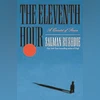
The Eleventh Hour: A Quintet of Stories
Edited by Salman Rushdie
Published by Penguin
254 pages, ₹899
Salman Rushdie’s latest opus is a many-splendored offering. It is a radiant display of the treasure trove of artefacts in the attic of his memory, some priceless gems, some not quite shiny, but none pallid, all placed in dazzling arrays of words. It is a now-you-see-them-now-you-don’t game where Rushdie has readers guessing the real-life person (or a mix of them) on which a fictionalised character is based. It is a serenade for the one true love of Rushdie’s, the siren city of Bombay before she was Mumbai. Above all, it is a meditation on intimations of mortality by one who has lived under a fatwa threat for ever so long and suffered a near-fatal knife attack three years ago but survived to tell his remarkable tale, at once emotional and rational. The last thing The Eleventh Hour is just a quintet of stories, as the dust jacket puts it rather prosaically.
Rushdie tells us, with barely concealed braggadaccio, that he knows something about mathematics of numbers, classical and popular music, both western and Indian, cinema old and new, cryptography, renaissance music, art and architecture and, of course, books and writers, with Franz Kafka as the subject of his supreme adoration. Bombay is everywhere in the book, even in “In the South,” a story located in Chennai. It becomes a central character in “The Musician of Kahani”. Since so many of the Rushdie tales originate in or are inspired by Bombay, it comes as no surprise that he chooses to call it Kahani. Renaissance and Kafka are the major influences in the spell-binding “Oklahoma”.
Two octogenarian men, “Palakkad Aiyars or Iyers,” identically named and almost the same age, the Senior older by 17 days than the Junior, occupy adjacent verandas in a mansion, like “death and life” in the tale “In the South”. Junior, who wants to live, dies after a small fall, but Senior, who wants so much to die, survives even the tsunami.
In “The Musician of Kahani,” a child prodigy born at the stroke of the millenium, destroys through the sheer power of her wrathful music the fraud godman for whom her rationalist mathematician father had abandoned his loving family and the ultra-rich but utterly unenlightened family whose scion she has married. In “Late,” we see the Honorary Fellow at (presumably) The King’s College, a one-book celebrity author (arriving via E M Forster and the computer science pioneer Alan Turing who chose chemical castration over a stiff prison term as punishment for his homosexuality in post-war Britain) after his death through the eyes of an Indian scholarship student, much like M Night Shyamalan’s The Sixth Sense, and cheer him on as he gets his long-sought revenge.
“Oklahoma” is not about the geographical American state, of the Osage Nation and the 1921 Tulsa race massacre, nor is it about the happy corn growing state of the 1943 Rodgers and Hammerstein musical, but the state that Karl Rossman of Kafka’s Amerika reaches after a long rail journey over a vast land, which could be “some sort of personal fulfilment.” Actually, what Rushdie means is the final fulfilment, a disappearance or “[d]eath]… a form of disappearance.”
A young writer of Indian origin residing in Britain but visiting America, a stand-in for Rushdie, stalks Uncle K, a celebrated author, presumably an imagined Kafka, seeking the approval of the one he considers his mentor. K asks the author to finish Rossman’s story. After the author has shifted to the United States, K makes his exit, through a meticulously planned disappearance. The author meets K some time later, and is vastly surprised to see K as his much older self.
The story has many layers. Embedded in it is an account of Fransisco Goya’s Black period, during which he painted Saturn devouring his son. The author examines himself through what he presumes is K’s lens, who sees him as a fraud. “You stole real people and put them in your book,” Auntie K tells him, speaking for her missing husband, a reprimand he accepts upon reflection.
But lest we conclude that Rushdie has presented us an honest assessment of himself as a writer, he also enters a caveat: It is “a narrative that is untrue and therefore true, as fiction is” and adds: “The inexact chronology and deliberately imprecise locations… are essential to its dreamlike quality.” Should that also cover glitches like “wipe off that glummery from your kisser?” Even the most boorish Rushdie characters could not be imagined to utter such gauchery!
With this tale, has Rushdie, too, entered his Black period, I wonder. He is about the same age as Goya was (“an old man, …had a crazy old man screaming into his ear, as if death were screaming at life, here I am, old fool”) and lives in relative isolation, with Eliza Griffiths as his companion, much like Goya had his much younger Leocadia Weiss in that period. Let us hope not, but Rushdie frequently mentions death, disappearance and descent into madness in the same context. This meditative novella is easily the best in the collection.
“The Old Man in the Piazza,” is a polemic, a parable, championing discourse and argumentativeness against enforced agreements of the “Yes” period. Originally published during the first Donald Trump presidency, it is now even more relevant, and not just in America or the West, but the world over. It has language (with small l, signifying it could be any tongue, written or spoken) as a character, sitting silently in the piazza. She is lately surrounded by a bunch of young fan(atic)s, who care not for purity or beauty, which greatly distressed her as it should us, too.
Rushdie’s last novel, the joyous, boisterous, Victory City ended thus: “All that remains is this city of words. Words are the only victors.” Three years later, his conclusion of The Eleventh Hour is “Our words fail us.”
This should worry us, seriously worry us, coming as it does from the acclaimed Merlin, the prophet and wizard of words.
The writer is a Baroda-based economist