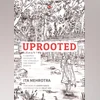
Uprooted: A Graphic Account of the Struggle for Forest Rights
by Ita Mehrotra
Published by Context
144 pages ₹599
What is a nation for? What is a government supposed to do? The textbook answer is that governments are supposed to protect its citizens, to serve those who grant it authority. But what if the government is your biggest threat? When, in the name of conservation, your disappearance is demanded? When development begins with your displacement? When the forest you’ve tended, protected, known by its bark and seasons and animal movements, suddenly belongs to a government that wants you gone?
“Wild animals and forest fires don’t scare us. We know very well how to deal with all that. What is scary is the threat of the Junglaat and sarkar,” Noorjahan, a Van Gujjar woman, tells Ita Mehrotra. The junglaat—the forest department—and the sarkar—the state—are more dangerous than any predator, more destructive than drought or flame.
Ita Mehrotra’s Uprooted, through evocative prose and stunning black-and-white illustrations capturing years of fieldwork, narrates the displacement of Van Gujjar and Taungya communities across Uttarakhand’s Terai region—communities that know forests intimately. Yet under Indian conservation law, they’re squatters. Ms Mehrotra’s book, then, is a visual counter-archive of displacement, of resistance.
The Van Gujjars are semi-nomadic Muslim buffalo herders who have migrated seasonally between the Himalayan foothills and alpine meadows for centuries: Winter in the lower valleys (deras), summer in high pastures (bugyal), the entire year calibrated to the needs of their herds and the forest’s capacity. They prevent forest fires (critical in Uttarakhand’s climate crisis), manage grazing to maintain biodiversity, create firebreaks, sustain water sources, essentially operate as a “middle unit” between wildlife and settled communities.
Yet under Indian law, they remain squatters. The Van Gujjars don’t own the land they’ve managed for generations; it’s common property administered by state forest departments, who inherited the British colonial permit system devised to extract grazing fees and regulate “professional graziers”. When Rajaji National Park was notified in 1983, traditional practices like lopping—cutting tree branches for fodder without harming the tree—were suddenly illegal. Grazing was now trespassing. The 2006 Forest Rights Act should have changed this, but state governments rejected their applications. Over 1,600 families have been displaced from Rajaji alone since.
Each year, the Van Gujjars present their documents and pay grazing and lopping taxes, a ritual inherited from colonial times and now overseen by forest department officials. With every new park notification, every new conservation drive, their territory shrinks. Bureaucratic goodwill determines your access. Survival hangs on annual stamps and the promise that next season, their movement won’t be blocked. Displacement is a daily possibility.
The state, beyond displacing communities, also manufactures the conditions for further displacement. “When the forests were cut down to make plots for the Resettlement Colony, all the animals ran towards the one area left uncut. So, of course, the State thought it profitable to turn that area into a wildlife park!” First, displace communities, then use concentrated wildlife as justification for protected areas. Next: “in the name of afforestation, the Department has planted hundreds of Kanju Papri plants here, which is an extremely invasive species. It will slowly kill the native trees around and drain the soil. Then the birds and animals will vanish from here. And then the Department will find some excuse to develop what they will wrongly call a ‘wasteland’.”
The Taungya communities may not herd buffaloes, but they, too, share the Van Gujjars’ predicament, that of state-engineered impermanence. The Taungya system, imported by the British from Burma, allowed farmers to cultivate between rows of commercial timber trees for two or three years while saplings matured. Once the canopy closed and crops failed, families were moved to repeat the process on new land.
What the British called the forestry partnership was actually unpaid labour establishing monoculture plantations — communities disposable once their work was done. Post-independence India inherited the model as ecosystems were converted into timber farms, while Taungya workers remained temporary, in perpetuity, their rights lasting only as long as the forest department needed them.
Ms Mehrotra sketches herself into panels —o bserving, questioning, laughing. This self-insertion brings a more personal lens, not treating the communities as “the other”. Her lush illustrations work in two directions: Showing the ecological richness of the forests while foregrounding the emotional and identity crises displacement creates. In one image, Anita’s grandmother’s hands —a woman from Haripur Taungya —sprawl across the page, rough like bark, leaves growing from wrinkles. The distance between labour and land is removed: Her hands planted these trees, her body carries their history.
In another, Ms Mehrotra zooms into a fallen leaf, a woman walking its midrib like a path. The visual grammar, more than metaphors, documents inseparability. Where the state sees squatters, the drawings display architects of ecosystems. It’s a visual refutation of conservation’s false binary, that forests must be either preserved or inhabited. These communities don’t live “in” the forest; they live “with” it.
Who truly belongs to the land, and who gets to decide? This is the question at the heart of Uprooted. The answer, in contemporary India, is the state. The state that inherited colonial forest laws and abuses them with the same sensibility that once governed subjects, not citizens. The book insists that these lives — constantly surveilled by the state, treated as problems to be managed —deserve visibility, dignity. It reminds us that when we speak of forests, we must also speak of the people whose lives are rooted in them. Because a forest without people isn’t preservation. It’s another kind of uprooting.
The reviewer is a journalist, writer, and editor fascinated by the stories that shape our world.
Instagram/X: aroomofwords