CAPITALISM: A Global History
By Sven Beckert
Published by Penguin Press
1,325 pages $49
Marcus Rediker Any book about capitalism that begins almost 900 years ago in the port city of Aden, in what is now Yemen, promises a new story. In Capitalism, the Harvard historian Sven Beckert delivers on that promise with an epic 1,300-page account of the global leviathan that created the world in which we live.
During the Cold War, capitalism was the global force that dared not speak its name. To this day, most of Beckert’s fellow historians rarely link their local, regional or even national histories to the larger system of which they are a part. Beckert has now proved once and for all the necessity of naming the global beast in order to reveal its vast power, past and present.
Never before has so much qualitative and quantitative evidence been brought to bear on so broad a reinterpretation of this story. Previous histories have usually treated capitalism as a European invention, but Beckert, as ambitious as he is erudite, shows how capitalism arose as a global phenomenon, the peculiar behaviour of a few merchants in places as far apart as Cairo and Changzhou.
By mapping the diverse origins of capitalism, Beckert reveals its protean and resilient character. Over hundreds of years, merchants created small enclaves of capital within port cities and elaborate networks of trust that stretched over long distances.
In the 17th century, the sugar-producing island of Barbados became one of the first capitalist societies, and silver-producing Potosí (in present-day Bolivia) became one of the first capitalist cities. As many as a quarter of the people who descended into Potosí’s mines died in them, Beckert writes, but “wealthy Potosíans could buy Ceylonese diamonds, Neapolitan stockings, Venetian crystal and Chinese porcelain.”
Many histories of capitalism are abstract, structural and narrowly economic, but Beckert enriches his story by recreating for the reader the places where his subjects made their fortunes — the medieval merchant hubs of Central Asia, the sugar plantations of the Indian Ocean and the “production floors of 20th-century industrial behemoths” that pumped out cars in Detroit. He travels to the Cambodian capital of Phnom Penh, where he interviews a textile worker at the factory gate and then weaves her experiences into his epilogue.
Beckert also humanises his history by anchoring it in the lives of specific capitalists like the Godrej family in British India. Committed nationalists, the Godrejs began manufacturing everyday goods like locks and safes at the turn of the 20th century and helped to finance the Indian independence movement. They turned a big profit on the decline of the British Empire in the late 1940s, when their early support for the future Prime Minister Jawaharlal Nehru helped them win a contract to make typewriters for the post-colonial bureaucracy.
Beckert’s book arrives on a crowded and bloody battlefield, where intellectual, cultural and geopolitical war has been waged for more than two centuries about what capitalism is and what the story of its rise might tell us. He offers an especially devastating critique of earlier mythologies of capitalism, showing how the “invisible hand” of the market does not peacefully guide world affairs, and how the development of capitalism was in no sense “natural.”
Two leading thinkers of the 18th century, the French philosopher Montesquieu and the Scottish political economist Adam Smith, argued that world trade promoted peace and harmony because it advanced mutual interest and interdependency.
Beckert emphasises how capitalism has depended at every stage of its development on the military power of the modern state and frequently on practices of extreme violence, such as the outright terror required to build the Atlantic system of slavery.
Even though Beckert pays close attention to technological developments like the steam engine and the railroad, he says remarkably little about the European tall ship, the machine that powered the conquest of the world from the 15th through the 18th centuries, and even less about the sailors whose labour made possible the creation of the world market. The book is fundamentally terracentric.
Workers and labour history in general do, however, play a central role in Capitalism. Labourers on plantations and in factories exert a collective force, often through acts of rebellion and resistance, especially during the Haitian Revolution and the many phases of the Industrial Revolution.
Their main impact was to slow down the advance of capital and to create more humane features, such as the welfare state, within it. Yet these movements against capital do not get the same human face as the actors who advanced its cause around the globe. The book is more a study in political economy than a history from below.
Still, Capitalism is a learned, formidable and vivid story. Its grand synthesis will engage not only general readers, but thousands of specialists, many of whom will object to this or that interpretation or omission. That is as it should be. Readers around the world will study and ponder this monumental work of history, agreeing and arguing with it, all the while affirming its generational importance for decades to come.
The reviewer is a historian at the University of Pittsburgh ©2025 The New York Times News Service


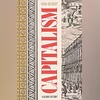 "A new book reviews the global history of how capitalism took over the world")

