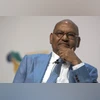
Billionaire industrialist Anil Agarwal has revealed plans to double the size of his mining giant Vedanta through a strategy centred around demerger, diversification and deleveraging, according to a report by the Press Trust of India.
Speaking at
Vedanta Ltd’s 60th annual general meeting (AGM) on July 4, Agarwal told shareholders that each of the businesses being demerged has the potential to grow into a $100-billion company.
“Our 3D strategy—demerger, diversification and deleveraging — will enable us to double in size and unlock maximum value for our stakeholders,” he said.
“Our demerger proposal has received support from over 99.5 per cent of shareholders and creditors. This is a vote of confidence like no other,” he added, pointing out that the company is in the final stages of restructuring. “Once implemented, for every share held in Vedanta Ltd, each shareholder will receive one share in each of the four demerged companies.”
Focus on technology and innovation
Vedanta also plans to collaborate with 1,000 startups in the technology sector. “This will make Vedanta one of the largest innovation hubs, nurturing the next generation of technology champions who will shape the future of Bharat,” Agarwal said at the AGM.
Following the demerger, Vedanta will form independent companies focused on aluminium, oil and gas, power, iron and steel, and zinc and silver.
'House of cards': What short-seller Viceroy Research said
The AGM took place a day after US-based short-seller Viceroy Research published a report targeting Vedanta’s parent firm, Vedanta Resources Ltd (VRL), labelling it a “parasite” that is “systematically draining” Vedanta Ltd, as earlier reported by Business Standard.
Viceroy, which has taken a short position in VRL’s debt, alleged in an 87-page report that the group is a “house of cards built on a foundation of unsustainable debt, looted assets and accounting fiction”.
In its report, the short-seller described VRL as a “financial zombie”, allegedly relying on unsustainable cash flows from Vedanta Ltd to service its own debt. The report alleged that the group’s balance sheet is being weakened through excessive borrowing, manipulated accounting and masked cash transfers under the guise of brand fees and inter-company loans.
“This looting erodes the fundamental value of Vedanta Ltd, which constitutes the primary collateral for VRL’s own creditors,” the report said. “Consequently, VRL’s actions to meet its short-term obligations directly impair its creditors’ long-term ability to recover their principal, a situation that resembles a ponzi scheme.”
Vedanta’s rebuttal and future vision
A Vedanta group spokesperson called the report an attempt to mislead stakeholders. “The report is a malicious combination of selective misinformation and baseless allegations to discredit the group. It has been issued without making any attempt to contact us, with the sole objective of creating false propaganda,” the spokesperson said.
“Our stakeholders are discerning enough to understand such tactics. To avoid any responsibility, the authors have included disclaimers stating the report is for educational purposes and merely expresses opinions, not facts.”
The group compared the allegations to the 2023 accusations levelled by now-defunct Hindenburg Research against the Adani Group.
Share price impact and debt exposure
Shares of Vedanta Ltd dropped by 3.38 per cent following the release of the report. Hindustan Zinc Ltd (HZL), a subsidiary of Vedanta Ltd, also saw its shares fall by 2.56 per cent.
These declines raise concerns, as the entire stake of VRL in Vedanta Ltd is pledged, and 93.5 per cent of Vedanta Ltd’s stake in HZL is also pledged with lenders.
Expanding footprint and critical minerals push
Vedanta Ltd, a unit of UK-based Vedanta Resources, operates in India, South Africa, Namibia, Liberia, the UAE and Saudi Arabia, spanning oil and gas, metals, minerals, power and electronics.
Agarwal pointed out that while India’s geology is comparable to resource-rich countries like Canada and Australia, only about 25 per cent has been explored so far. The company has secured 10 critical mineral blocks across the country, one of the highest by any private firm.
It is also setting up the world’s first industrial zinc park and India’s largest aluminium park, aimed at supporting MSMEs and generating large-scale employment—marking what Agarwal described as the start of a “metal revolution” in India.

 "Anil Agarwal unveils 3D strategy to double Vedanta's business size")


