Home / Companies / News / ArcelorMittal Nippon Steel gets green certification under new taxonomy
ArcelorMittal Nippon Steel gets green certification under new taxonomy
ArcelorMittal Nippon Steel India's flat steel products have received government-certified green steel status under the steel ministry's new taxonomy, helping customers cut Scope 3 emissions
The certificate was issued by the National Institute of Secondary Steel Technology.
3 min read Last Updated : Feb 05 2026 | 2:13 PM IST
ArcelorMittal Nippon Steel India (AM/NS India) has received green steel certification under the Ministry of Steel’s new green steel taxonomy, the company said on Thursday.
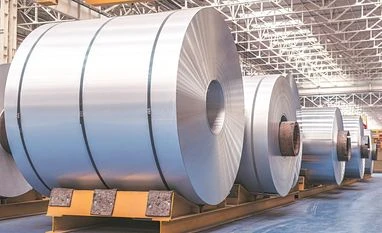
AM/NS India’s hot rolled (HR) coils and sheets have achieved a four-star rating, while cold rolled (CR) coils and sheets have secured a three-star rating.
These products, which are key inputs for the automotive, infrastructure, defence, construction equipment and consumer durables sectors, are now officially recognised as government-certified green steel. This will enable customers to reduce Scope 3 emissions across their value chains, the company said.
The certificate was issued by the National Institute of Secondary Steel Technology (NISST), the nodal agency for issuing green steel certificates and star ratings in India. The qualifying threshold for emission intensity under the framework is less than 2.2 tonnes of carbon dioxide equivalent per tonne of finished steel (tCO2e/tfs). AM/NS will have to pay a fee of ₹2 per tonne for the certification.
Addressing the media, Dilip Oommen, Chief Executive Officer of ArcelorMittal Nippon Steel India, said that in December 2024 India became the first country globally to introduce a formal green steel taxonomy. “We are very proud that AM/NS has become the first integrated steel plant to be certified under the Government of India green steel taxonomy. The future of steel is low-carbon,” he said.
Oommen added that the milestones had been achieved without losing competitiveness in the cost of production, a challenge that is often faced by European nations.
The company said this was supported by its steelmaking structure, with around 65 per cent of capacity based on the direct reduced iron (DRI) route using natural gas. This significantly reduces reliance on coal-based processes.
Responding to a question on whether a premium would be charged for green steel, Oommen said, “We are not discussing the commercial part right now. But a lot of effort has gone into this.”
Ranjan Dhar, Director and Vice-President (Sales and Marketing), AM/NS India, said there were two parts to the green steel initiative.
Apart from exporting directly, the focus was on providing customers who export, such as auto component makers and manufacturers of yellow goods, with green steel solutions so that they remain competitive in the global market.
Even though India’s green steel framework and the European Union’s Carbon Border Adjustment Mechanism (CBAM) are two different systems, the development is expected to benefit AM/NS India’s exports.
Arvind Bodhankar, Chief Sustainability Officer of AM/NS India, said that with regard to CBAM and green steel, the taxonomies were directed towards low-carbon steel production. “And green steel is also low-carbon steel production. So eventually it will help us,” he said.
The European Union is the single largest market for Indian steel exports. On the India–US trade deal and its impact on steel, Dhar said details were awaited. “But the initial feedback that we have got is that there should not be any change because no change is expected in Section 232 or other anti-dumping duties currently in place for exports of steel from India to the US,” he said.
He, however, added that tariffs on exports of auto components, wheels and axles were expected to come down. “That should benefit our customers and additional demand should come to Indian steel producers,” Dhar said.


 "ArcelorMittal Nippon Steel gets green certification under new taxonomy")

