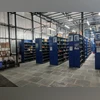
It’s a rainy Monday morning in Noida, and a crowd of delivery riders in neon tees wait patiently outside a nondescript building. There are no shopfronts, no signs, and certainly no customers walking in or out. Yet this inconspicuous warehouse is fulfilling grocery orders for thousands — often in under 10 minutes.
Welcome to a dark store.
One of over 700 across the country run by Bigbasket, this facility spans about 6,000 square feet. It’s a critical cog in the machine that powers India’s burgeoning quick commerce sector — a behind-the-scenes agglomeration of nationwide hubs built for speed, efficiency, and absolute invisibility to the end user. Interestingly Bigbasket has opened some of its dark stores to customers so that they can check hygiene and quality of goods, likely a fallout of recent surprise checks that found dismal conditions at a rival qcom player.
Inside, the tempo never falters. Pickers and packers, men and women in near-equal numbers, tap away at phones and dart between narrow aisles. Each is assigned one order at a time — automatically routed through a central dashboard. Each picker gets a mere 3-4 minutes to complete their task. For a delivery that is promised to be done in 10-15 minutes, this sprint is critical.
With trolleys or paper bags in hand (depending on the order size), they race down tightly-packed rows marked A through F — past shelves stacked with masalas, baby lotion, biscuits, and bulky 5 kg bags of atta (wheatflour). Smaller and fast moving goods are near the packing stations, while bulkier items like flour are in the back. The app on their phone guides them aisle by aisle, shelf by shelf - not unlike an Ikea self-pickup area - ensuring precision with every barcode scan. Speed is not just encouraged; it’s engineered into the system.
At the packing station, the order is checked and sealed, then placed on an open-sided rack near the store’s entrance. That’s where the delivery riders step in.
Almost as soon as the order is marked complete, a rider’s phone pings. The location of the package — shelf and all — is shared with him. The rider - picked at random - collects the order, puts it in the bag on his two-wheeler, and marks the beginning of the journey on his phone.
The dashboard monitors this, too. Ideally, the gap between a packed order being shelved and a rider picking it up is mere seconds — especially if the rider is already waiting outside.
Back inside, the hum of operations continues. A new order comes in — cold beverages, frozen snacks, and ice cream. A packer slips on a jacket and steps into the temperature-controlled cold zone, navigating racks of milk, soft drinks, and frozen treats. Safety instructions are pinned outside; cold zones are not to be entered casually. The process remains the same — quick, exacting, always on the clock.
Over a 30-minute window, the dashboard reports an average order-to-door time of just over 18 minutes. The store-in-charge sits glued to his laptop, tracking metrics, troubleshooting issues, and preparing for the next surge.
Even as the day winds down elsewhere — in nearby offices and homes — the dark store shifts into its next phase. Riders change shifts, orders spike again, and the beat goes on. Later in the night, trucks will arrive, snaking their way through muddy lanes to replenish the fast-emptying shelves. The cycle never stops.
Come tomorrow, the pace may be even quicker. The festive season is around the corner, and with it comes a new wave of orders — more instant, more frequent, more demanding.
Behind-the-Scenes
How a qcom order is delivered
1. Customer places an order
2. Orders assigned to a picker/packer
3. Picker/Packer packs items in 3-4 mins
4. Picker/Packer keeps the bag on a shelf
5. Delivery rider picks the bag from the shelf
6. Delivery rider reaches the customer's doorstep