Bangladesh boycott T20 World Cup 2026 in India despite ICC assurances
The decision was reaffirmed on Thursday following a high-level meeting in Dhaka involving the Bangladesh Cricket Board (BCB), senior players and the government's sports adviser,
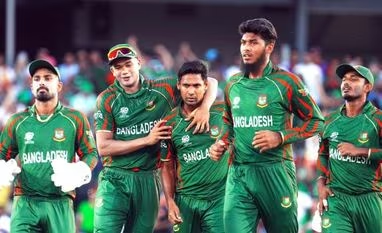
Anish Kumar New Delhi Bangladesh have taken the extraordinary step of boycotting the ICC Men’s T20 World Cup 2026 in India, defying repeated assurances from the global governing body on security and logistics.
The decision was reaffirmed on Thursday following a high-level meeting in Dhaka involving the Bangladesh Cricket Board (BCB), senior players and the government’s sports adviser, making it clear that the team will not travel to India under the current schedule. Bangladesh had sought to have their matches shifted to Sri Lanka, but the ICC has refused to amend the fixtures.
With the standoff now entrenched, Bangladesh face exclusion from the tournament, with Scotland set to replace them.
Government-backed boycott hardens Bangladesh’s position
BCB president Aminul Islam said the board would return to the ICC with its proposal to play in Sri Lanka, rejecting what he described as an ultimatum issued by the governing body. He questioned the ICC’s authority to impose a deadline and warned that the tournament would lose out on Bangladesh’s massive television audience if the team was excluded.
Aminul also dismissed the ICC’s characterisation of Sri Lanka as a co-host, calling it a hybrid arrangement rather than a shared hosting model, and said some of the discussions at the ICC board level had been deeply concerning.
Government sports adviser Asif Nazrul made it clear that the decision carried state backing, stating that it was the government that had decided Bangladesh would not travel to India. While expressing hope that the ICC might still reconsider, he left little doubt that Bangladesh’s stance was firm.
ICC stands by schedule, dismisses security concerns
The ICC, however, has refused to yield. After a board meeting held via video conference, the governing body confirmed that the World Cup would proceed as scheduled, with Bangladesh’s matches remaining in India.
In a detailed statement, the ICC said it had considered multiple security assessments, including independent reviews, all of which concluded there was no credible threat to the safety of Bangladeshi players, officials, media or fans. It added that changing the schedule so close to the tournament was not feasible and could undermine the neutrality and integrity of future ICC events.
The ICC also said it had shared comprehensive venue-level security plans and host government assurances with the BCB over several weeks, but Bangladesh had continued to link participation to an unrelated domestic issue involving one of its players — a connection the ICC said had no bearing on tournament security.
Scotland set to replace Bangladesh
With Bangladesh unwilling to honour the published fixtures, the ICC has made it clear that the team will be replaced if it does not participate. Scotland, next in line based on qualification criteria, are expected to step in, reshaping the tournament lineup just weeks before the World Cup begins.
The move would mark a rare instance of a qualified team being replaced at an ICC event due to a boycott rather than on-field results.
Players face financial losses amid boycott
The boycott carries significant consequences for Bangladeshi players, who now stand to lose match fees, tournament bonuses and the financial upside that comes with participating in a global ICC event. While the decision has been framed as a matter of national policy, individual players will bear the economic cost of missing cricket’s shortest format’s biggest stage.
As the ICC presses ahead and Bangladesh holds its ground, the crisis has exposed the limits of cricket diplomacy. With no sign of compromise from either side, the T20 World Cup 2026 now appears set to go ahead without Bangladesh — a decision that could leave lasting scars on the game’s global governance.

 "Bangladesh boycott T20 World Cup 2026 in India despite ICC assurances")


