
'BCCI Ranji diktat..: State units agree with Rohit's 'hunger' comment
Several representatives from state associations admitted that Rohit was not off the mark when he said those who are not up for it should not be considered for the toughest format
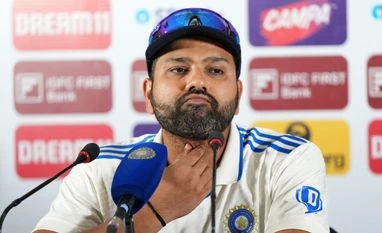 "'BCCI Ranji diktat..: State units agree with Rohit's 'hunger' comment")
WebinarsNew
Deep DiveNew
Explore Business Standard
Several representatives from state associations admitted that Rohit was not off the mark when he said those who are not up for it should not be considered for the toughest format
India skipper Rohit Sharma's assertion that Test opportunities should be only for those who show hunger for the format found resonance with state associations grappling with youngsters desperate to make a name in white-ball cricket but reluctant to grind it out in first-class games.
With the advent of IPL, the club vs country debate has been raging for years now and Rohit's stern statement came at a time when two established names in Indian cricket -- Shreyas Iyer and Ishan Kishan -- ignored a BCCI diktat to play Ranji Trophy quarterfinals, focussing instead on their IPL preparations.
"Jin logon ko bhookh hai, hum unhi logon ko mauka denge (We will give opportunities to only those who are hungry)," Rohit declared on Monday after a series-clinching win over England in the fourth Test in Ranchi.
"Agar hunger nahi hai to unko khila ke koi matlab nahi hai (There's no point in playing those who don't have the hunger)," he said.
The hunger that he spoke about was there for everyone to see in young guns like Yashasvi Jaiswal, Sarfaraz Khan, Dhruv Jurel, Akash Deep and the more established Shubman Gill, all of whom sparkled at various stages of the series against England.
But Rohit did make a point about the unnamed ones who don't seem to have that fire in the belly.
"I concur with the Indian captain. There should be hunger in younger cricketers to play the longest format," Abhilash Khandekar, president of Madhya Pradesh Cricket Association, told PTI.
It is for those that the BCCI issued a directive earlier this month asking centrally-contracted cricketers to be available for Ranji engagements.
Several representatives from state associations admitted that Rohit was not off the mark when he said those who are not up for it should not be considered for the toughest format. But they also feel that a system needs to be in place so that such a situation never arises.
"Ranji Trophy cannot be taken lightly by any player, it is the backbone of Indian cricket. It is the most important tournament in domestic cricket. This should be followed up in other formats in domestic cricket," Khandekar said.
Another official, who did not wish to be named, went to the extent of saying that Ranji Trophy ran the risk of "a slow death if it was not made mandatory for top players to compete."
State units see the parent body's move as a case of better late than never.
"I complement BCCI for this decision of compelling players to play for their state in Ranji Trophy. I see it as a case of better late than never, this is going to help domestic cricket in a big way," said Khandekar.
In the recent past, the Indian batters have been found vulnerable on turning tracks at home.
Former India captain Dilip Vengsarkar believes if elite players turn up for their respective states in Ranji Trophy whenever available, it would only make them better players of spin.
"Playing Ranji is very important. It helps you play spin better on Indian wickets, your overall skills are improved. And when you play foreign teams, it becomes easier (to face spin)," said Vengsarkar, himself a great player of spin.
"I feel it is a player's wish whether to play Ranji or not. If he doesn't want to play, we have enough in India to choose from, they will play and establish themselves. No one is bigger than the game. No one is indispensable," he said.
In Kishan's absence from the ongoing series, Dhruv Jurel made the most of the opportunity by coming up with two brilliant under-pressure knocks in only his second Test.
Like the MPCA chief, a state unit official proposed another step to rein in players who ignore red-ball cricket.
"This was a much needed step and should have been taken earlier. If an India player is regularly featuring in Ranji Trophy, it acts a massive motivator to the younger players in the squad.
"I would also want the BCCI to empower state units to ban those players who don't play Ranji Trophy. If a senior is dropped for once, the juniors would not dare to ignore their red ball commitments for T20 cricket," said a state unit official requesting anonymity.
(Only the headline and picture of this report may have been reworked by the Business Standard staff; the rest of the content is auto-generated from a syndicated feed.)
First Published: Feb 28 2024 | 8:22 AM IST

