U.S. prices increased less than expected in February, with the cost of services outside housing and energy slowing significantly, keeping a June interest rate cut from the Federal Reserve on the table.
The report from the Commerce Department on Friday also showed consumer spending rising by the most in just over a year last month, underscoring the economy's resilience. The United States continues to outperform its global peers despite higher borrowing costs, thanks to persistent labor market strength.
"Core services inflation is slowing and will likely continue throughout the year," said Jeffrey Roach, chief economist at LPL Financial in Charlotte, North Carolina. "By the time the Fed meets in June, the data should be convincing enough for them to commence its rate normalization process."
The personal consumption expenditures (PCE) price index rose 0.3% last month, the Commerce Department's Bureau of Economic Analysis said. Data for January was revised higher to show the PCE price index climbing 0.4% instead of 0.3% as previously reported. Goods prices rose 0.5% last month, boosted by a 3.4% jump in the cost of gasoline and other energy products.
There were also strong increases in the prices of recreational goods and vehicles as well as clothing and footwear. But prices for furnishings and household equipment, and other long-lasting manufactured goods were subdued.
In the 12 months through February, PCE inflation advanced 2.5% after increasing 2.4% in January.
Economists polled by Reuters had forecast the PCE price index gaining 0.4% on the month. Though price pressures are subsiding, the pace has slowed from the first half of last year.
Fed officials last week left the U.S. central bank's policy rate unchanged in the current 5.25%-5.50% range, having raised it by 525 basis points since March 2022.
Policymakers anticipate three rate cuts this year. Financial markets expect the first rate reduction in June. Fed Governor Christopher Waller said on Wednesday, "there is no rush to cut the policy rate" right now, but he did not rule out trimming borrowing costs later in the year.
Most U.S. financial markets were closed for the Good Friday holiday, with the exception of the foreign exchange market. The dollar slipped against a basket of currencies on the data.
Excluding the volatile food and energy components, the PCE price index increased 0.3% last month. That followed an upwardly revised 0.5% gain in January. The so-called core PCE price index was previously reported to have advanced 0.4% in January.
Core inflation increased 2.8% year-on-year in February, the smallest gain since March 2021, after rising 2.9% in January.
The Fed tracks the PCE price measures for its 2% inflation target. Monthly inflation readings of 0.2% over time are necessary to bring inflation back to target.
Services prices increased 0.3%, slowing after a 0.6% jump in January. The cost of housing and utilities rose 0.5%. There were also solid increases in the prices of recreation services as well as financial services and insurance.
But the cost of dining out and hotel and motel rooms was unchanged, while transportation services barely rose and healthcare increased marginally.
PCE services inflation excluding energy and housing gained 0.2% last month after surging 0.7% in January. Policymakers are monitoring the so-called super core inflation to gauge their progress in fighting inflation.
With inflation slowing consumers boosted their spending.
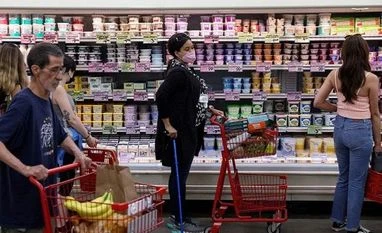
Consumer spending, which accounts for more than two-thirds of U.S. economic activity, jumped 0.8% last month. That as the largest gain since January 2023 and followed a 0.2% rise in January.
When adjusted for inflation, consumer spending rebounded 0.4% after dropping 0.2% in January. The increase in the so-called real consumer spending suggested that consumption likely retained most of its momentum in the first quarter, which bodes well for the economy's prospects.
But much of the spending was funded from savings as growth in personal income slowed. The saving rate dropped to 3.6%, the lowest level since December 2022, from 4.1% in January.

 "US monthly inflation slows, consumer spending surges, reveals data")


