New Delhi is expecting that the 10 trillion yen ($67 billion) Japan has pledged in private investments over the next decade will slot directly into the government’s effort to supercharge small and medium enterprises (SMEs) and startups, seen as the core engines of job creation.
The hope in India is that these investments will give muscle to Prime Minister Narendra Modi’s vision of competitive federalism, with Indian states reaching out to Japanese prefectures to “make in India, make for the world” — and, crucially, to “make in India with Japan, export to the world,” especially to Africa, West Asia, and Southeast Asia.
In the past two years alone, India and Japan have signed 170 Memoranda of Understanding (MoUs) worth $13 billion in committed investments.
Officials believe the latest announcement could double the number of Japanese companies registered in India from the present 1,400, half of them in manufacturing.
According to government sources, Japanese partnerships are steadily pulling Indian SMEs into global supply chains. Tokyo Electron’s investments, Fujifilm’s tie-up with Tata Electronics to create a semiconductor ecosystem, Toyota and Suzuki integrating hundreds of tier-two and tier-three SMEs into their value chains, and Fujitsu hiring 9,000 Indian engineers at its global capability centre are all part of the picture.
The government’s assessment is upbeat: Indian SMEs will gain global-standard practices, advanced technology, and wider market access, lifting export competitiveness.
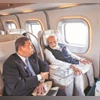
At Friday’s summit, Modi and Japanese Prime Minister Shigeru Ishiba signed a raft of agreements. But the symbolism of Saturday, the final day of Modi’s two-day visit, was equally deliberate. The two leaders boarded the Shinkansen bullet train to Sendai, 300 km from Tokyo, to tour a semiconductor plant in Miyagi prefecture. Modi also met governors from 16 of Japan’s leading prefectures in Tokyo, appealing to them to strike partnerships with Indian states.
Drawing on his own political past, Modi reminded them of his many visits to Japan during his 13 years as Gujarat’s chief minister. “I have closely seen the potential and possibilities in our states and your prefectures,” he said. His message, though, was directed just as much at India’s current chief ministers: As CM of Gujarat, he said, his focus was “policy-driven governance, promoting industry, building strong infrastructure, and creating a conducive environment for investment”. Today, this is also known as the “Gujarat Model”.
Since 2014, he added, his government had “reinvigorated the competitive spirit in our states.”
The states-prefectures initiative, one of Friday’s agreements, is intended to lock that spirit into international cooperation: At least three Indian states and three Japanese prefectures will exchange delegations every year. Some partnerships already exist: Gujarat with Shizuoka, Uttar Pradesh with Yamanashi, Maharashtra with Wakayama, Andhra Pradesh with Toyama, and Tamil Nadu with Ehime.
“We want Indian states to become hubs of international cooperation,” the PM said.
He pointed to the role of startups and SMEs from smaller towns in driving India’s growth story. Citing Suzuki Motor Corporation of Hamamatsu, which transformed India’s automobile sector, he urged governors to leverage the initiative across manufacturing, technology, innovation, mobility, infrastructure, startups and SMEs. Each Japanese prefecture, he said, brings niche strengths that could pair with India’s ambitions. Governors responded that sub-national links would be essential if bilateral cooperation is to reach its next level.
In Sendai, the leaders’ tour of Tokyo Electron Miyagi Ltd — a flagship of Japan’s semiconductor sector — became a showcase for the new momentum. The two countries have already signed the Japan–India Semiconductor Supply Chain Partnership.
“We hope to work together to strengthen the semiconductor supply chain and enhance economic security,” Ishiba said. Modi, for his part, called Japan a “tech powerhouse,” adding: “Japan’s technology and India’s talent can lead the global technology revolution.”
For India, Japanese investment offers a hedge against the impact of higher US tariffs and over-reliance on Washington. For Japan, its car industry — bruised by tariff hikes from the White House — is hungry to tap India’s vast market and youthful demographic.
Major Japanese commitments already on the ground include: ArcelorMittal-Nippon Steel’s ₹15 billion expansion in Gujarat and ₹56 billion integrated steel plant in Andhra Pradesh; Suzuki’s ₹350 billion investment for a new Gujarat plant and another ₹32 billion for production expansion; Toyota Kirloskar’s ₹33 billion enlargement in Karnataka, and a ₹200 billion new plant in Maharashtra.
Beyond industry, Japanese cooperation is reshaping India’s rural economy through green energy. Sojitz Corporation, working with Indian Oil, is investing $395 million to establish 30 biogas plants. Farmers will supply crop residues and agri-waste,
generating additional income while powering India’s clean energy transition. Suzuki, partnering with the National Dairy Development Board and local cooperatives, is launching a biogas initiative in Gujarat’s Banaskantha.
Exports are another prize. Hybrid vehicles jointly produced by Toyota and Suzuki in India are to be shipped to Africa, West Asia and Southeast Asia — the very regions cited as central to the India–Japan compact.
Ambitious vision
Japan partnerships are plugging more Indian SMEs into global value chains, which may mitigate the impact of higher US tariffs
Fujifilm–Tata Electronics: Building a semiconductor ecosystem with Indian SMEs as component suppliers
Toyota & Suzuki: Investments to bring in hundreds of tier-II and tier-III SMEs into their value chains
Fujitsu: Hiring 9,000 Indian engineers at its global capability centre, boosting IT-linked SMEs
ArcelorMittal–Nippon Steel: $15 bn Guj expansion and $56 bn Andhra integrated steel plant underway
Sojitz–Indian Oil: $395 mn investment in 30 biogas plants