'End human rights violations in occupied areas': India slams Pakistan at UN
India told the UN that Pakistan must stop human rights abuses in its occupied areas, reaffirmed Kashmir as part of India, and called for real reforms at the UN to make it more effective
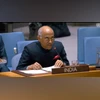
India’s Permanent Representative to the UN Ambassador Parvathaneni Harish (Photo: X/Screengrab)
Describing democracy as an "alien" idea for Pakistan, India has asked Islamabad to end grave human rights abuses in territories illegally occupied by it, stating that the population in these areas is openly resisting its military rule, repression, and exploitation.
Responding to Pakistan's statements at the UN Security Council’s open debate on “The United Nations Organisation: Looking into the Future” on Friday, India’s Permanent Representative to the UN, Ambassador Parvathaneni Harish, said, "The people of Jammu and Kashmir exercise their fundamental rights in accordance with India's time-tested democratic traditions and constitutional framework."
He added, "We, of course, know that these are concepts alien to Pakistan."
Harish reaffirmed India’s stance on Kashmir, saying, "Jammu and Kashmir has been, is, and will always be an integral and inalienable part of India."
Criticising Islamabad, the Indian envoy said, "We call upon Pakistan to end the grave and ongoing human rights violations in the areas illegally occupied by it, where the population is in open revolt against Pakistan's military occupation, repression, brutality and illegal exploitation of resources."
Harish also stressed the need for meaningful reforms at the UN. He highlighted that the Security Council’s structure, designed over 80 years ago, no longer reflects today’s geopolitical realities. "An outdated Council architecture that mirrors the geopolitical realities of 1945 is not equipped to handle the challenges of 2025," he said.
He called for expanding both permanent and non-permanent membership through “time-bound” and “text-based negotiations” and said the Global South must have a stronger voice in global decision-making. "Postponing reforms indefinitely does immense disservice to our citizens, especially in the Global South," he noted, referring to the bloc of countries that represent the majority of humanity and face unique challenges in development, climate, and financing.
Making global governance more inclusive
Highlighting India’s commitment to multilateralism, Harish said, "The world must move beyond pennies and posts to craft a new vision for the UN that is more agile and responsive to global challenges such as pandemics, terrorism, economic instability, and climate change."
He pointed out concerns over the UN’s relevance, legitimacy, credibility, and effectiveness. He also warned that international cooperation is increasingly being seen as charity, with prosperity restricted amid limited access to resources and technology.
"Progress that is not universal is neither sustainable nor tenable in moral terms or on a practical basis," the Indian envoy said.
Harish called for more agile UN mechanisms, noting that peacekeepers face evolving challenges and require realistic mandates, adequate resources, and technological support.
While structural adjustments are welcome, he argued they are not enough. He urged the UN to use its 80th anniversary as an opportunity for “real, comprehensive reforms” of the organisation and its principal bodies. He also stressed revitalising the General Assembly as the UN’s key deliberative and policymaking body, ensuring better coordination with the Security Council to uphold the UN Charter’s purposes.
Cautioning against using the UN for divisive politics, Harish said, "In a world fractured and fragmented along multiple fault lines, the United Nations... is the only vehicle we possess to harness our collective energies for global public good."
Invoking India’s civilisational ethos of Vasudhaiva Kutumbakam, the world is one family, he urged member states to unite in creating a UN that is fit for purpose in the modern era.

 "'End human rights violations in occupied areas': India slams Pakistan at UN")


 Connect with us on WhatsApp