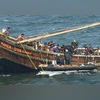
The Indian Coast Guard has seized three Bangladeshi fishing boats and detained 79 fishermen for illegally entering and fishing inside India’s Exclusive Economic Zone (EEZ), the coast guard said on Tuesday.
The coast guard said the boats were intercepted during an operation carried out between November 15 and 16. It said the vessels were operating in Indian waters without the mandatory permits, which was a violation of the Maritime Zones of India (Regulation of Fishing by Foreign Vessels) Act, 1981.
In an X post, the coast guard said, "India Coast Guard apprehended three Bangladeshi fishing boats along with 79 crew for illegal fishing inside the Indian EEZ on 15-16 Nov 25, operating without mandatory permits in Indian waters."
Boats, crew handed to WB Marine Police
All three boats and their crew members were handed over to the West Bengal Marine Police in Frazerganj for further legal action.
The Coast Guard said the operation reflects its continued efforts to protect India’s maritime borders, uphold sovereign rights, and safeguard marine resources.
What does Maritime Zones of India Act say?
The Maritime Zones of India (Regulation of Fishing by Foreign Vessels) Act was signed in 1981 to provide for the regulation of fishing by foreign vessels in certain maritime zones of India.
According to the rules, no foreign vessel, except those with a licence or permit, shall be used for fishing within any maritime zone of India. It also states that if a foreign vessel enters India’s maritime zone without a valid licence or permit, it must keep all its fishing gear properly stowed at all times while in that zone.
Violators will face strict penalties
If a foreign vessel is used illegally in India’s waters, strict penalties apply. According to the Act, violations in territorial waters can lead to up to three years in jail, fines up to ₹15 lakh, or both, while violations in the EEZ can result in fines up to ₹10 lakh.
If convicted under these provisions, the foreign vessel, along with its fishing gear, equipment, supplies, cargo, and any fish on board, is confiscated, and all such seized items become the government’s property.

 "Indian Coast Guard seizes 3 Bangladeshi boats, 79 crew for illegal fishing")



