PM Modi raises concern of Hindus' safety in Bangladesh in I-Day speech
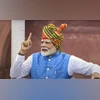
In his Independence Day speech from the ramparts of the Red Fort in the national capital, Modi said India is committed to peace and that it will remain a well-wisher of Bangladesh
Modi's remarks came amid mounting concerns in New Delhi over widespread incidents of attacks on the minority Hindu community in Bangladesh. | PTI Photo
4 min read Last Updated : Aug 15 2024 | 7:49 PM IST
Prime Minister Narendra Modi on Thursday hoped that the situation in violence-hit Bangladesh will return to normal soon even as he said 140 crore Indians are concerned over the safety of Hindus and minorities in the neighbouring country.
In his Independence Day speech from the ramparts of the Red Fort in the national capital, Modi said India is committed to peace and that it will remain a well-wisher of Bangladesh in its development journey.
Modi's remarks came amid mounting concerns in New Delhi over widespread incidents of attacks on the minority Hindu community in Bangladesh after Prime Minister Sheikh Hasina resigned and fled to India on August 5 following weeks of violent unrest.
"As a neighbouring country, I can understand the concern regarding whatever has happened in Bangladesh. I hope that the situation there will become normal soon," Modi said.
"In particular, the concerns of 140 crore countrymen is that the safety and security of Hindus and minorities there is ensured. India always wants that the neighbouring country marches on the path of peace and prosperity," he said.
The prime minister said India will remain a well-wisher in Bangladesh's development journey, in what is being seen as an indication of New Delhi's readiness to work with the new dispensation in Dhaka.
"We have a commitment to peace. In the coming days, we will continue to wish well for Bangladesh in its journey towards development because we are people who think about the well-being of humankind," he said.
It was the second time in the last one week that Modi raised concerns over the condition of minorities in Bangladesh.
While extending best wishes to Muhammad Yunus after he took charge as the head of Bangladesh's interim government on August 8, Modi had talked about ensuring the safety of Hindus and other minority communities in that country.
In a post on X, Modi said: "We hope for an early return to normalcy, ensuring the safety and protection of Hindus and all other minority communities."
"India remains committed to working with Bangladesh to fulfil the shared aspirations of both our peoples for peace, security and development."
Days after Hasina fled to India, the interim government, headed by Nobel-laureate Yunus, was sworn in on August 8, along with 16 advisers.
On Tuesday, Yunus reached out to Hindus in Bangladesh as he visited the Dhakeshwari temple in Dhaka and said his government would punish those who attacked the minority community members.
Hasina (76), who ruled Bangladesh with an iron hand for 15 years, resigned as the prime minister following massive protests that initially began as an agitation against a job-quota scheme but weeks later, morphed into a mass movement demanding her ouster from power.
The controversial quota system provided for 30 per cent reservation in civil services jobs for the families of veterans who fought the 1971 Bangladesh Liberation War.
According to reports from Dhaka, nearly 500 people were killed in weeks of violent clashes before Hasina's resignation.
Meanwhile, Rashtriya Swayamsevak Sangh (RSS) chief Mohan Bhagwat said in Nagpur that Hindus living in Bangladesh are being subjected to violence for no reason and that India has the responsibility to ensure that they do not face any injustice and atrocities.
"We can see the situation now. A lot of violence is taking place in the neighbouring country and Hindus living there are facing the heat without any reason," Bhagwat said.
External Affairs Minister S Jaishankar, in a statement in Parliament on August 6, said India is "deeply concerned" over the situation in Bangladesh, especially about the status of the minority communities.
"We are also monitoring the situation with regard to the status of minorities," he said.
(Only the headline and picture of this report may have been reworked by the Business Standard staff; the rest of the content is auto-generated from a syndicated feed.)


 "PM Modi raises concern of Hindus' safety in Bangladesh in I-Day speech")

