Finance Ministry dept to meet business correspondents, banks next week

Senior executives of banks to attend discussion; commissions and penalties for sector on agenda
The Union Ministry of Finance is planning to consolidate the Regional Rural Banks (RRBs) under a policy of “One State, One RRB” to improve their efficiency and avoid undue competition among sponsoring public sector banks.
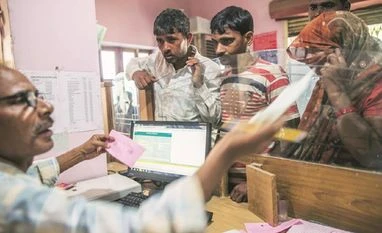
Business correspondents are a key part of proving banking in rural areas. (Representative photo)
Raghu Mohan New Delhi
3 min read Last Updated : Jan 19 2025 | 11:15 PM IST
The Department of Financial Services (DFS) has called a meeting of the monitoring committee on the functioning of business correspondents (BCs) on January 21.
 
Among the key discussion points, sources said, are the payment of fixed commissions to BCs in rural centres by banks and the waiver of penalties. The setting up of an infrastructure and equity fund for corporate BCs is to be explored, with the option of tapping the National Bank for Agriculture and Rural Development’s Financial Inclusion Fund and the Reserve Bank of India’s (RBI’s) Payments Infrastructure Development Fund for the same.
 
The meeting will be attended by representatives of the Business Correspondent Resource Council (BCRC), the Business Correspondent Federation of India, the Indian Banks’ Association, and senior officials from both state-run and private banks.
 
The meeting will essentially revisit the issues highlighted by the working group set up under the chairmanship of C S Setty, which submitted its report in December 2022. Setty (currently chairman of State Bank of India, was then the bank’s managing director), and his committee’s terms of reference were as follows: a bouquet of services to be offered by BCs to increase their income stream; a commission-sharing arrangement between corporate BCs and their agents; graded commission services in rural, semi-urban, urban, and metro areas; categorisation and gradation of BCs for services based on their expertise and qualifications; and the liquidity crisis faced by them.
 
BCs have recently been raising the issue of the BC channel’s viability with the Ministry of Finance, warning that it is becoming increasingly unviable. In November last year, the BCRC raised these concerns during a meeting with the Minister of State for Finance Pankaj Chaudhary.
 
Commission rates set more than a decade ago have not been adjusted for inflation or rising operational costs, diminishing the channel’s profitability. This stagnation has severely impacted bank mitras, particularly in rural and semi-urban regions, leading to high attrition and loss of livelihood.  ALSO READ: Business correspondents meet Irdai, seek consent to sell insurance products
 
The growing emphasis on financial inclusion has also deepened the interaction between BCs and the broader financial system, highlighting the need for better governance standards, higher investments, and sustainable business models. Many field agents are leaving the BC channel, lured by better opportunities with ecommerce companies such as Amazon, Flipkart, and Blinkit.
 
BCs are heavily reliant on cash-in, cash-out — industry jargon for cash deposits and withdrawals — and there is limited training in value-added services. This impacts their ability to sell other financial products like insurance or mutual funds.
 
To address these issues, stakeholders are calling for intensified capacity-building efforts, better training for field staff, and the development of a larger pool of skilled trainers. It was also pointed out that complementing the BC channel are the 75 digital banking units (DBUs) set up by the RBI from April 2022.
 
DBUs are brick-and-mortar outlets equipped with infrastructure to execute banking functions such as opening accounts, accessing government schemes, and making transactions digitally. By mid-December 2023, there were 96 DBUs.
 
TALKING POINTS
  1. Review of decade-old commission rates 
  2. Discussion on penalty waivers
  • Proposed fund for corporate BCs using Nabard and RBI funds.
  • Revisiting C S Setty’s 2022 report.
  • In attendance BCRC, BCFI, IBA, and senior bank officials.


One subscription. Two world-class reads.

Already subscribed? Log in

Subscribe to read the full story →
*Subscribe to Business Standard digital and get complimentary access to The New York Times

Smart Quarterly

₹900

3 Months

₹300/Month

SAVE 25%

Smart Essential

₹2,700

1 Year

₹225/Month

SAVE 46%
*Complimentary New York Times access for the 2nd year will be given after 12 months

Super Saver

₹3,900

2 Years

₹162/Month

Subscribe

Renews automatically, cancel anytime

Here’s what’s included in our digital subscription plans

Exclusive premium stories online

  • Over 30 premium stories daily, handpicked by our editors

Complimentary Access to The New York Times

  • News, Games, Cooking, Audio, Wirecutter & The Athletic

Business Standard Epaper

  • Digital replica of our daily newspaper — with options to read, save, and share

Curated Newsletters

  • Insights on markets, finance, politics, tech, and more delivered to your inbox

Market Analysis & Investment Insights

  • In-depth market analysis & insights with access to The Smart Investor

Archives

  • Repository of articles and publications dating back to 1997

Ad-free Reading

  • Uninterrupted reading experience with no advertisements

Seamless Access Across All Devices

  • Access Business Standard across devices — mobile, tablet, or PC, via web or app

Topics :Financial InclusionIndian BanksFinance Ministry

Next Story



