As artificial intelligence steadily moves from pilot projects to primary care clinics, the question looms: are frontline health workers ready? At the India AI Impact Summit 2026 in New Delhi on Wednesday, the panel titled Workforce Readiness for Artificial Intelligence in Primary Healthcare brought together leaders from government, academia, and global institutions to discuss what AI readiness means when it comes to AI in healthcare.
Beyond the promise of smarter triage, faster diagnosis, and improved population health management, the discussion focused on the practical realities, including role-based competencies, ethical safeguards, and implementation pathways needed to ensure that digital tools are adopted safely, effectively, and at scale across India’s primary health system.
Skilling and reskilling in AI for primary healthcare workers
Speaking during the panel discussion, Dr Sachin Sharma, Director, DAKSHIN, hosted at the Research and Information System for Developing Countries (RIS), said, “As PM said, we require skilling and reskilling. We need that in health also.”
Primary healthcare workers are already stretched, he said, and adding AI tools without preparing them is like handing someone a cockpit without flight training.
Dr Mona Duggal from the Indian Council of Medical Research (ICMR) pointed out that medical education has not yet fully adapted to this shift. “The medical professionals really need to upskill themselves,” she said, adding that senior professionals often have deep experience but may be less technologically savvy than the younger generation. “Given the new ecosystem with AI, everybody needs to upskill themselves.”
She stressed rethinking medical curricula to include AI tools as part of an MD thesis. She further suggested turning state-level projects into digital learning opportunities. Upskilling, she stressed, is required at both the “input and output level” of health projects. Even national programme managers approving grants must understand how AI is being used.
In other words, AI literacy cannot be limited to tech teams. It has to become a
core health systems skill.
Global South lessons for AI adoption in primary healthcare
India has recently launched AI guidance for healthcare. According to Dr Monika Kochar, Health, DAKSHIN, RIS, the country is “rearing to go ahead.” But she cautioned against going it alone.
“When we talk about India’s strength, we are at the helm of it,” she said. Yet, she emphasised the importance of cooperation across resource-constrained settings. DAKSHIN, she explained, was created to institutionalise learning across Global South countries.
“It is about what we learn from others, learning the best practices, challenges of the Global South countries.”
She emphasised that AI in primary healthcare cannot be a copy-paste model from high-income settings. It must reflect local realities such as workforce constraints, infrastructure gaps, and community-level challenges.
Digital foundations and primary care workforce transformation
Dr Ranjana Kumar, CEO of Centre of Excellence (CHAKRA), Nashik, reminded the audience that India’s primary healthcare workforce has already delivered large-scale
digital transformations.
“In this age, unless you embrace technology, unless you embrace the new tools that are coming in, you’ll be really overwhelmed,” she said.
She pointed to the digitisation of immunisation through programmes like UWIN and CoWIN. Much of that groundwork was done by primary healthcare workers. “All this digitisation was done by primary healthcare workers,” she noted.
But structured digital health education matters, she highlighted. Through CHAKRA, foundation courses in digital health are now being offered to undergraduate and nursing students.
She also highlighted interoperability, which is the ability of digital systems to talk to one another. That, too, depends heavily on frontline workers who enter, manage, and validate data.
Rethinking medical education and AI use in healthcare
Professor Anurag Agrawal, Biosciences and Health Research, Ashoka University, took the discussion into deeper waters.
“AI has changed the game quite a bit,” he said. Skills centred on information retention and production will become less relevant. The ability to use AI effectively will become more relevant.
But he warned against overdependence. Healthcare workers must be able to perform critical tasks even without digital tools. At the same time, they should be empowered to use AI “in such a way that they become the most productive version of themselves.”
That balance, he argued, requires rethinking education and evaluation systems. At times, digital access should be cut off during assessments to test core skills. At other times, AI use should be encouraged, with questions designed to push boundaries.
He went further: “The health of the future will not look like the health of today.” Data science and engineering mindsets will increasingly shape healthcare. Yet, in India, medical and engineering colleges remain siloed.
Opening a department of health informatics within a medical college, he suggested, will not be enough. What’s needed is a true ecosystem where domain experts can break down problems into solvable parts and apply AI thoughtfully.
“We want to produce more AI geniuses,” he said, “but what we need are more domain knowledge people with a wide grounding genius in breaking down the problem.”
According to him, AI readiness is not about creating coders in white coats; it is about producing clinicians who understand problems deeply and can harness technology intelligently.

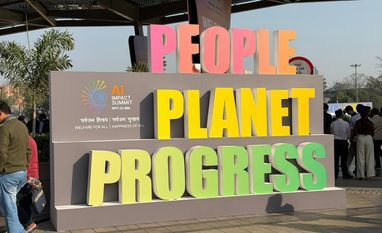 "AI Impact Summit: Scaling in primary healthcare for workforce readiness")


